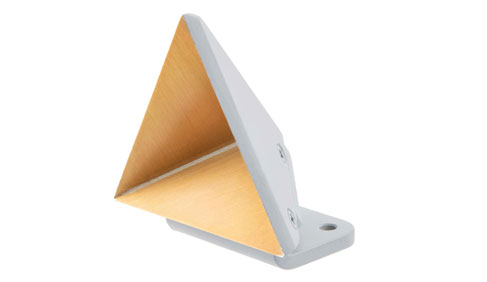

What Makes a Military Antenna, Military-grade?
Key Takeaways
Military antennas differ from commercial antennas in several important ways:
- Compliance with military standards such as MIL-STD-810 and TAA, ensuring durability and government suitability.
- Wideband and high-performance RF characteristics for reliable communication across multiple frequency bands.
- Interoperability and mounting standards are required for defense platforms and allied systems.
- Application-specific design for mission-critical communications, navigation, data links, and electronic warfare.
Core Requirements of Military-Grade Antennas
Military-grade antennas are built to meet demanding communication needs in some of the harshest environments on earth. Their core requirements include rugged durability, the ability to operate across wide temperature ranges, and resistance to shock, vibration, and moisture. Unlike commercial antennas, they must deliver secure and reliable communication in environments where dust storms, heavy rain, salt fog, or rapid temperature shifts are normal. These antennas also need stable electrical performance—low VSWR, wide bandwidth, and consistent radiation patterns to support mission-critical systems without signal loss or interference.
Key Design Characteristics That Differentiate Military Antennas
Several design elements make military antennas fundamentally different from standard commercial units. They often use reinforced housings, corrosion-resistant metals, or advanced composites that can survive battlefield conditions. The internal elements are engineered for high efficiency, wider coverage across multiple frequency bands, and low passive intermodulation to preserve signal clarity. Connectors and mounts are strengthened to avoid performance degradation from vibration or impact. Many military antennas also include stealth-optimized radomes, flexible mounting options, and multi-band configurations to support radios, data links, and navigation systems simultaneously.
Performance Expectations: Bandwidth, Gain & Reliability
Military communication systems depend on antennas that offer strong performance across multiple technical parameters. They require wide bandwidth for multi-frequency and multi-mission capabilities, from long-range HF communication to high-data-rate microwave links. Gain must remain stable across the operating band to ensure predictable coverage and reliable point-to-point communication. These antennas also need low noise, minimal distortion, and high power-handling capacity, especially radar, jamming, or electronic warfare systems. Above all, performance must remain consistent even when the antenna is subjected to environmental or mechanical stress.
There is a growing use of military antenna in a wide range of applications, including aerospace, naval, land-mobile, manpack, and unmanned vehicles. These communications can be anything from critical voice or text communication between units/central command or a communication link with an unmanned vehicle many miles away from the control hub. In all these use cases, and many non-military use, such as oil/gas, railroad, overland, extreme environment, or other extreme applications, ruggedness that doesn’t sacrifice electrical performance is necessary. Fortunately, there are military antennas designed specifically to offer military-grade ruggedness and fulfill the performance requirements of modern communications systems, examples include the 790 MHz to 2700 MHz Electronic Warfare Omni Antenna, and 1.15 GHz to 1.4 GHz L-band Omni Antenna.
These antennas differ from typical industrial-/commercial-grade antennas in that they are designed and tested to meet certain military specifications/standards (MIL-SPEC) and otherwise have design features that support military-style applications. For instance, military-grade antennas should be designed and tested to meet MIL-STD-810 standards for humidity, shock, vibration, blowing rain, immersion, impact, etc. Other important features include a temperature range consistent with military electronic requirements, namely from -40 to +71 ℃. Many military applications also have relatively high-power requirements for compact, portable, or low-profile antennas that are not typical with most industrial or commercial applications.
Example features that will differentiate military antennas from commercial/industrial antennas are mounting hole pattern differences, materials/color, and TAA compliance. For instance, it is not uncommon for military-grade antennas designed to be mounted externally to a chassis to have US 4 hole or NATO 3/16-hole patterns. Military-grade antennas need to be constructed of materials that can handle the harsh environments and extreme conditions presented by military applications. Lastly, US Trade Agreement Act (TAA) compliance is important for many of these antennas, which is generally not a consideration for commercial/industrial antennas.
As many modern military applications use the same frequency ranges as commercial/industrial applications, as evidenced by military communication networks increasingly relying on 4G LTE/5G and other non-proprietary wireless networking technology, military-grade and commercial/industrial antennas are likely to have overlapping frequency ranges. Though, a military antenna’s frequency range capability may be listed in common radar band designations, which is less common for commercial/industrial antennas.
Frequently Asked Questions (FAQs)
Q1: What makes a military antenna different from a commercial antenna?
A: A military antenna is specifically engineered for ruggedness, environmental durability, military standard compliance, and wideband performance — features that commercial antennas typically do not prioritize to the same degree.
Q2: Why are MIL-STD-810 standards important for military antennas?
A: MIL-STD-810 tests certify that antennas can survive conditions like high/low temperatures, humidity, shock, vibration, and other environmental stresses that are common in defense operations.
Q3: Do military antennas operate on different frequencies than commercial antennas?
A: Many military antennas support broad frequency ranges or specific defense bands to meet tactical and strategic communication needs, whereas commercial antennas often target consumer or standardized telecom bands.
Q4: What types of applications use military antennas?
A: They are used for vehicle navigation, personnel radio communication, GNSS/GPS, tactical data links, electronic warfare, jamming systems, and secure military networks.
Related articles
Peter McNeil | Oct 25, 2022 | Antennas
There are a wide range of antenna technologies available today. A more recent option is to choose a multi-input multi-output (MIMO) antenna. Though newer, is a MIMO antenna better than a traditional single-input single-output SISO antenna? More is always better right? This is certainly not the case with SISO and MIMO antennas, and like virtually every RF circuit/signal chain, the antenna is a critical component that needs to be precisely specified for a given application and that decision making needs to include the other devices/components in the system.
A SISO antenna is a single-port antenna that has a single driven element, though the antenna could be balanced or unbalanced depending on the design. A MIMO antenna, on the other hand, is an antenna system that consists of at least two distinct antennas. Each of the MIMO antenna elements has a distinct input port that is designed to be driven individually from a MIMO compatible radio. In theory, a MIMO antenna may be driven like a SISO antenna by splitting the power from a SISO radio to the multiple MIMO antenna elements. However, this likely won’t provide substantial benefit, and an appropriate SISO antenna would probably provide better performance, especially considering the intrinsic losses associated with introducing any passive elements in a signal chain.
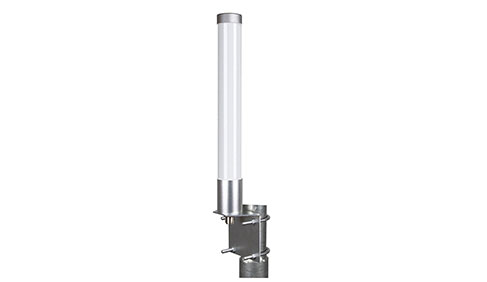
SISO Omni Antenna
In order to make the most of a MIMO antenna, a MIMO radio is needed. This could be a WiFi or cellular system that makes use of MIMO technology and spatial multiplexing to provide higher throughput than is possible with a single spatial channel.
The number of MIMO channels, radio hardware/protocol, and channel quality determines the overall throughput gain possible compared to a SISO antenna system. If the radio hardware/protocol or channel quality is poor, then a MIMO system may not provide any substantial benefit over a SISO system. Hence, knowledge of the channel and radio technology are critical in determining if a MIMO antenna is appropriate. If the application is appropriate and the communication link is between two MIMO-equipped nodes, then it is possible to achieve many times the throughput of a comparable SISO communication link. It is important to note that MIMO isn’t necessarily using different frequency bands to increase throughput but is instead using spatial multiplexing to create separate spatial channels with their own communication stream.
Generally, the only reason to employ a MIMO system is to provide greater throughput, possibly to a larger number of devices in a given region. MIMO systems are intrinsically different and should not be confused with beamforming antenna systems, though an advanced antenna system (AAS) may be both MIMO and beamforming capable.
Peter McNeil | Feb 02, 2026 | Antennas
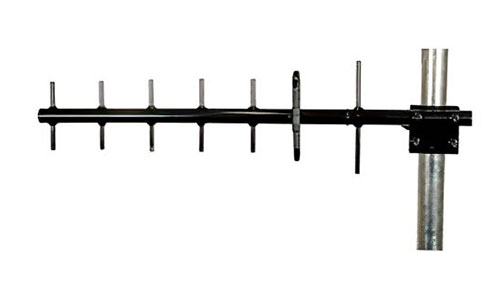
A Yagi-Uda Antenna (Yagi Antenna), named after the co-inventors Hidetsugu Yagi and Shintaro Uda, is a direction antenna with a single driven dipole section with a series of parasitic elements (directors) that re-radiate energy from the main dipole thus manipulating the antenna pattern. The parasitic elements of a Yagi antenna are within the near field of the main dipole, and hence significantly alter the antenna pattern as compared to a dipole without parasitic elements. The overall effect results in a much more directional antenna pattern, with the antenna pattern being dedicated by the spacing and length of the main dipole and parasitic elements.
Key Takeaways
A Yagi-Uda antenna uses a driven element plus parasitic elements (reflector and directors) to focus radio energy in a chosen direction. The reflector boosts forward gain by suppressing backward radiation, and directors further narrow the beam and increase forward gain.
Each additional director contributes diminishing returns in gain increase. High-gain Yagis tend to have narrow bandwidth, require precise element spacing and mechanical support, and often need impedance matching for proper feedline connection.
The front-to-back ratio is an important metric for interference rejection, but designing for a high F/B ratio may conflict with maximizing forward gain or bandwidth. Yagi antennas excel in fixed, directional, and narrowband scenarios such as point-to-point links, rural connectivity, broadcast reception, and amateur radio.
What Is a Yagi-Uda Antenna
A Yagi-Uda antenna (commonly called a Yagi) is a directional antenna that uses a driven dipole element plus a set of parasitic elements (a reflector and one or more directors) to shape its radiation pattern. The parasitic elements are not electrically connected to the feedline. Instead, they receive energy from the driven element and re-radiate it in controlled ways so that radiation in one direction is reinforced and radiation in other directions is canceled or reduced. This arrangement transforms an omnidirectional dipole-like pattern into a directional beam.
How the Number of Elements Affects Yagi Performance
Increasing the number of parasitic elements directly influences the Yagi’s gain, directivity, and beamwidth. More directors generally lead to higher forward gain and a narrower radiation pattern, making the antenna more directional.
Impact on Gain and Beamwidth
Each additional director typically adds a small amount of forward gain—usually around 0.5 to 1 dB—while also narrowing the beamwidth. This increases the antenna’s ability to focus energy and reject signals from undesired angles.
Diminishing Returns with Additional Directors
After a certain point, adding more directors yields minimal gains and improvements while increasing mechanical complexity. Beyond roughly 10–15 elements, physical size grows significantly, but performance improvements become marginal.
Directional Yagi Antenna
Yagi Antennas are a type of fixed antenna and are often mounted on a mast or pole and can be used indoors or outdoors depending on their IP rating. Some examples of Yagi Antennas include the FMANLP1005 Yagi Antenna which operates in the 5 GHz band to provides highly focused directional connectivity. The FMANLP1010 Yagi Antenna offers 14 dBi of gain along with vertical polarization and operates in the 3 GHz band to address 5G, LTE, CMDA, LoRA, IoT, WIFI applications.
A Yagi antenna also typically has a reflector section positioned “behind” the driven dipole element to further aid in increasing the directivity of the antenna. The reflector is often a series of conductive shafts, or mesh, typically about 5% longer than the driven element, and can consist of one or more shafts spaced “behind” the driven element. The reflector may also wrap around the “sides” or “top” and “bottom” of the Yagi antenna to further concentrate the antenna radiation in the forward direction.
The impact of the reflector is to increase the gain in the forward direction by reducing the radiation in the reverse direction of the antenna and focusing that radiation instead in the forward direction of the antenna (adds around 4 or 5 dB of gain to the forward direction. Though careful design can largely reduce sidelobe development, sidelobes are still developed that reduce the overall gain of the Yagi antenna.
The directors also add gain in the forward direction, by capturing and re-radiating the radiation that would otherwise spread out in a dipole antenna pattern. In this way, the Yagi antenna gain is a function of the number of directors added to the front of the antenna. There is a point at which the benefit to gain of designing in additional direction begins to diminish, with a maximum Yagi antenna gain limited to around 20 dB for a single antenna. By adding more directors the beamwidth of the Yagi antenna narrows along with increasing gain, which results in a practical limit for certain applications.
Moreover, the spacing and size of the Yagi antenna directors and mechanical structure to support the antenna structure results in a practical limit for the gain and directivity of low frequency Yagi antennas. This is due to the larger spacing and director lengths needed for efficient operation at lower frequencies. Hence, high gain Yagi antennas with high directivity are also naturally long antennas. A common figure-of-merit for a Yagi-Uda antenna is the front-to-back ratio. This is simply a ratio of the antenna radiation in the forward direction of the antenna and the reverse direction of the antenna, often expressed in a log ratio (dB).
The bandwidth of a Yagi antenna is also a function of the size of the Yagi antenna, namely the length, diameter, and spacing of the elements. Yagi antennas typically have a maximum percent bandwidth that is a few percent of the designed center frequency. The number of elements also reduces the bandwidth of a Yagi antenna, so a higher gain Yagi antenna also has a narrower bandwidth along with higher directivity. Therefore, when designing a Yagi-Uda antenna, there are generally trade-offs with the key performance parameters of gain/directivity, frequency of operation, bandwidth, size, and front-to-back ratio.
Explore our wide range of RF Antennas.
FAQs (Frequently Asked Questions)
Q1: What makes a Yagi antenna directional?
A: The driven element works with parasitic elements that reradiate energy in a way that reinforces forward radiation and reduces backward energy.
Q2: How does the front-to-back ratio affect performance?
A: A higher ratio improves rejection of interference coming from behind the antenna, which is useful for crowded RF environments.
Q3: How many directors should a Yagi have?
A: Adding more directors increases the gain but with diminishing improvement. Practical designs balance gain with mechanical size and bandwidth.