


What Are High Power RF Terminations Used For?
Key Takeaways
- High-power RF terminations safely absorb RF energy and prevent damaging signal reflections.
- They are essential for unused ports, switched RF paths, and high-power transmitter outputs.
- Proper termination improves VSWR, protects amplifiers, and enhances system reliability.
- Connector type and power rating must align with frequency and thermal requirements.
- High-power RF terminations are widely used in telecom, aerospace, radar, and test systems.
What Are High Power RF Terminations Used For?
High-power RF terminations, also commonly referred to as RF loads or dummy loads, are passive components used to safely absorb RF energy at the end of an unused port or signal path, converting that energy into heat with minimal signal reflection. They play a critical role in RF, microwave, and millimeter-wave systems where unused or switched signal paths must be properly terminated to maintain system stability, protect hardware, and preserve signal integrity. Fairview Microwave
In practical systems, high-power terminations are used whenever a transmitter or test signal might otherwise be left open-circuited or mismatched, which can cause damaging reflections or unintended energy feedback. For example, in transmitter chains with switched front-ends or during rapid switching operations in radar and communications systems, a high-power RF termination absorbs the residual RF energy when the active signal path is disabled. Fairview Microwave
Common Use Cases
1. Unused Port Termination
In multiport RF devices such as couplers, hybrids, circulators, or switch matrices, unused ports must be terminated to prevent reflected energy from re-entering the system and causing distortions or damage. High-power terminations provide the matched load that eliminates these reflections.
2. Test & Measurement Systems
In test setups, especially with live signals, unused test ports on analyzers, network analyzers, or signal generators must be terminated to avoid unstable measurements or inadvertent reflections that corrupt test data. Terminations ensure repeatability and accuracy in laboratory environments.
3. Transmitter Protection
Communications equipment, including cellular base stations, satellite transceivers, and radar systems, often incorporates switchable paths. When a transmitter path is disengaged, a high-power termination can safely absorb the residual RF energy, prevent overload, and protect sensitive components.
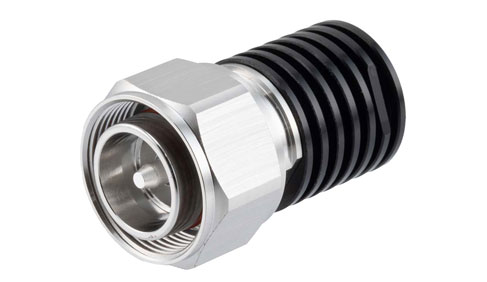
A valuable tool for terminating any unused port or signal chain that may produce more energy than can be safely handled within the system is a high-power RF termination. RF terminations are used to absorb unwanted RF signal energy and convert that energy into heat. A key aspect of high-power RF terminations is the ability to absorb the energy directed to them with minimal reflections. With the rise of sub-6 GHz wireless applications, especially extended range communication and sensing, components such as high-power RF loads that operate to 6 GHz, are extremely useful in the laboratory and in the field.
There are many situations in communications and sensing applications where the RF energy from a transmitter needs to be stopped prior to other communication or sensing functions. This could be for radars with a switched front-end or for communication transmitters with a switched filter bank output. Other examples included when a communication or sensing circuit needs to go silent as quickly as possible or if a part fails and there is excess signal energy in the signal chain that needs to be safely dumped or it could damage other components. In the laboratory, there are many cases where a given signal path may need to be terminated while live during a test setup before being used, or the signal energy used in testing a device needs to be terminated when an output is switched. Some components and devices involved in high power signal chains may also need to be terminated with a high-power RF termination, such as directional couplers, circulators/isolators, hybris, signal generators, test transceivers, transmitters, etc.
This is why it is important for a high-power RF termination to be able to handle the sustained input power and peak input power while providing good VSWR across the frequency band of operation. For cellular systems, Satellite Communications (Satcom), distributed antenna systems (DAS), test/measurement, and radar, the common sub-6 GHz coaxial standards include DIN 7/16, 4.3-10, and N-type. Though there are other coaxial standards that operate in this frequency range and are commonly used for these applications, these coaxial standards are capable of carrying higher power levels and are more appropriate to high power RF terminations than an SMA, for example. Where a typical RF termination can handle a couple of watts of RF energy within the operation frequency range, high power RF terminations are typically designed to handle 5 Watts, 10 Watts, 50 Watts, or more.
FAQs (Frequently Asked Questions)
Q1: What is a high-power RF termination?
A: A high-power RF termination is a passive RF load designed to absorb high RF power levels while maintaining impedance matching and low signal reflection.
Q2: Why are RF terminations required in RF systems?
A: RF terminations prevent signal reflections that can damage components, distort signals, and degrade overall system performance.
Q3: Where are high-power RF terminations commonly used?
A: They are used in telecommunications infrastructure, radar systems, satellite communications, RF testing labs, and defense applications.
Q4: What happens if an RF port is left unterminated?
A: An unterminated port can cause signal reflections, increased VSWR, overheating, and potential failure of RF components.
Related articles
Peter McNeil | Aug 02, 2022 | RF Terminations
RF terminations are one of the most common RF components used in nearly every application and use case where RF systems are employed. An RF termination is simply a terminating impedance that is designed to match the impedance of the transmission line or waveguide used in the signal chain. For instance, if a 50 Ohm coaxial path is to be properly terminated, say at the reverse port of a directional coupler, then the appropriate termination would be a 50 Ohm coaxial termination that matches the connector type of the directional coupler. Another example may be an extra test port that is generally unused but may be useful during maintenance or diagnostic troubleshooting. If unterminated the test port would return undesirable reflections and otherwise leak signals out of the open-ended port. An RF termination would safely prevent signal leakage and absorb the signal energy that would otherwise be reflected in an open port.

2.4mm RF Terminator
Another use case for an RF termination is if a transmit and receive signal chain are connected to an antenna via a switch as opposed to a diplexer or circulator. This is how many time domain duplex (TDD) and some radar operations. During a switching operation the transmitter signal energy would still be present for a short period of time. Hence, if the switch also changes the transmitter path to an RF termination with the appropriate ratings, the high-power RF from the transmitter can be safely terminated and absorbed. Otherwise potentially damaging reflections could occur as the input of an RF power amplifier or other transmission hardware has a limited reflected power handling capability.
RF terminations are also commonly used to terminate unused test ports in RF test and measurement equipment, such as a VNA. This is to prevent accidental reflections if a port is accidentally energized. If left open, the test port could cause damaging reflections to the sensitive test equipment receiver circuitry.
Given the various use cases of RF terminations, there are numerous types of RF terminations to better suit these use cases. For instance, there are some RF terminations meant for particularly high-power use cases. These RF terminations are generally larger in size and include a heat sink, often made from anodized aluminum. In more extreme high-power cases, an oil-filled terminator may be used, which uses oil to dissipate excess thermal energy. Some RF terminations even include active cooling systems for extremely high-power absorption.
However, many RF terminations are meant for lower power applications, such as those used with test and measurement equipment. These dummy loads are generally small and resemble an RF adapter. Some of these RF terminations may be multi-purpose and have two types of coaxial interface, one on either side. These are particularly useful in test and measurement applications where multiple coaxial connector types may be used in the same system.
Waveguide terminations are also common. Like with coaxial RF terminations, a waveguide termination may either be a simple length of waveguide with RF absorbing materials inside or include large heatsinks and even active cooling depending on the power rating of the termination.
Some RF terminations may also have other features, such as embedded O-rings for enhanced environmental performance, and clips/chains to ensure that a termination isn’t accidentally misplaced when temporarily removed.
