


Related articles
Peter McNeil | May 15, 2024 | RF Terminations
Key Takeaways
- High-power RF terminations safely absorb RF energy and prevent damaging signal reflections.
- They are essential for unused ports, switched RF paths, and high-power transmitter outputs.
- Proper termination improves VSWR, protects amplifiers, and enhances system reliability.
- Connector type and power rating must align with frequency and thermal requirements.
- High-power RF terminations are widely used in telecom, aerospace, radar, and test systems.
What Are High Power RF Terminations Used For?
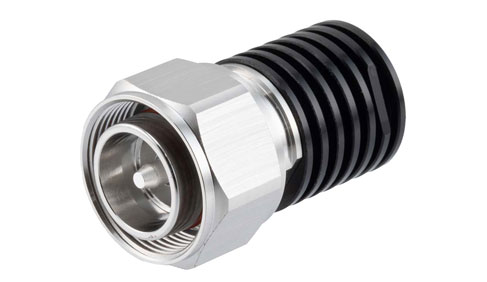
High-power RF terminations, also commonly referred to as RF loads or dummy loads, are passive components used to safely absorb RF energy at the end of an unused port or signal path, converting that energy into heat with minimal signal reflection. They play a critical role in RF, microwave, and millimeter-wave systems where unused or switched signal paths must be properly terminated to maintain system stability, protect hardware, and preserve signal integrity. Fairview Microwave
In practical systems, high-power terminations are used whenever a transmitter or test signal might otherwise be left open-circuited or mismatched, which can cause damaging reflections or unintended energy feedback. For example, in transmitter chains with switched front-ends or during rapid switching operations in radar and communications systems, a high-power RF termination absorbs the residual RF energy when the active signal path is disabled. Fairview Microwave
Common Use Cases
1. Unused Port Termination
In multiport RF devices such as couplers, hybrids, circulators, or switch matrices, unused ports must be terminated to prevent reflected energy from re-entering the system and causing distortions or damage. High-power terminations provide the matched load that eliminates these reflections.
2. Test & Measurement Systems
In test setups, especially with live signals, unused test ports on analyzers, network analyzers, or signal generators must be terminated to avoid unstable measurements or inadvertent reflections that corrupt test data. Terminations ensure repeatability and accuracy in laboratory environments.
3. Transmitter Protection
Communications equipment, including cellular base stations, satellite transceivers, and radar systems, often incorporates switchable paths. When a transmitter path is disengaged, a high-power termination can safely absorb the residual RF energy, prevent overload, and protect sensitive components.
A valuable tool for terminating any unused port or signal chain that may produce more energy than can be safely handled within the system is a high-power RF termination. RF terminations are used to absorb unwanted RF signal energy and convert that energy into heat. A key aspect of high-power RF terminations is the ability to absorb the energy directed to them with minimal reflections. With the rise of sub-6 GHz wireless applications, especially extended range communication and sensing, components such as high-power RF loads that operate to 6 GHz, are extremely useful in the laboratory and in the field.
There are many situations in communications and sensing applications where the RF energy from a transmitter needs to be stopped prior to other communication or sensing functions. This could be for radars with a switched front-end or for communication transmitters with a switched filter bank output. Other examples included when a communication or sensing circuit needs to go silent as quickly as possible or if a part fails and there is excess signal energy in the signal chain that needs to be safely dumped or it could damage other components. In the laboratory, there are many cases where a given signal path may need to be terminated while live during a test setup before being used, or the signal energy used in testing a device needs to be terminated when an output is switched. Some components and devices involved in high power signal chains may also need to be terminated with a high-power RF termination, such as directional couplers, circulators/isolators, hybris, signal generators, test transceivers, transmitters, etc.
This is why it is important for a high-power RF termination to be able to handle the sustained input power and peak input power while providing good VSWR across the frequency band of operation. For cellular systems, Satellite Communications (Satcom), distributed antenna systems (DAS), test/measurement, and radar, the common sub-6 GHz coaxial standards include DIN 7/16, 4.3-10, and N-type. Though there are other coaxial standards that operate in this frequency range and are commonly used for these applications, these coaxial standards are capable of carrying higher power levels and are more appropriate to high power RF terminations than an SMA, for example. Where a typical RF termination can handle a couple of watts of RF energy within the operation frequency range, high power RF terminations are typically designed to handle 5 Watts, 10 Watts, 50 Watts, or more.
FAQs (Frequently Asked Questions)
Q1: What is a high-power RF termination?
A: A high-power RF termination is a passive RF load designed to absorb high RF power levels while maintaining impedance matching and low signal reflection.
Q2: Why are RF terminations required in RF systems?
A: RF terminations prevent signal reflections that can damage components, distort signals, and degrade overall system performance.
Q3: Where are high-power RF terminations commonly used?
A: They are used in telecommunications infrastructure, radar systems, satellite communications, RF testing labs, and defense applications.
Q4: What happens if an RF port is left unterminated?
A: An unterminated port can cause signal reflections, increased VSWR, overheating, and potential failure of RF components.
Peter McNeil | Feb 14, 2024 | RF Terminations
At 26 GHz, there is substantial atmospheric absorption and much higher free space loss than at sub-6 GHz frequencies. Moreover, the interconnect such as 26 GHz attenuators and 26 GHz terminations, to drive a 26 GHz system intrinsically must be more compact than lower frequency interconnect, meaning that the power handling and loss of interconnect suitable for 26 GHz is greater than that of lower frequency interconnect.
Key Takeaways
- 26 GHz attenuators and terminations are essential for emerging high-frequency systems, including 5G FR2, radar, and satellite communications.
- High-precision attenuators help control signal levels, protect receivers, and maintain system linearity at mmWave frequencies.
- 26 GHz terminations ensure proper impedance of matching, reduce reflections, and improve accuracy in test setups.
- These components must be engineered with low VSWR, stable attenuation, and high-power handling to perform reliably at 26 GHz and beyond.
- Choosing the right part depends on factors such as connector type, attenuation accuracy, operating bandwidth, power rating, and environmental robustness.
Why 26 GHz Components Matter for Modern RF Systems
As RF systems push deeper into the millimeter-wave range, the need for components that can maintain performance at higher frequencies has become essential. The 26 GHz band is particularly significant because it sits at the lower end of mmWave, offering a balance of bandwidth, reliability, and manageable propagation loss. Technologies like 5G FR2, advanced radar, point-to-point microwave links, and satellite terminals increasingly rely on this frequency range for high-data-rate, low-latency communication. For these systems to operate efficiently, every element—from connectors and cables to attenuators and terminations—must maintain low VSWR, stable signal characteristics, and consistent power handling at 26 GHz. This is why dedicated 26 GHz components matter: they ensure signal integrity, minimize reflections, and deliver predictable performance in demanding high-frequency environments.
Key Applications for 26 GHz Attenuators
26 GHz attenuators play a critical role in controlling signal levels, protecting sensitive components, and improving accuracy in both field and lab settings. In 5G FR2 test environments, they are used to adjust signal strength when evaluating radio units, antennas, and user equipment operating near 26–28 GHz. In radar systems, attenuators help balance high-power transmit signals to ensure proper receiver sensitivity and prevent front-end overload. They’re also widely used in satellite communication links, particularly for Ka-band terminals to fine-tune uplink and downlink signal paths. RF labs rely on 26 GHz attenuators during calibration, verification, and production testing to simulate real-world conditions and evaluate device performance under controlled power levels. Across all of these applications, the goal is the same: stable, accurate attenuation that holds its value across the full 26 GHz bandwidth.
Choosing the Right 26 GHz Attenuator or Termination
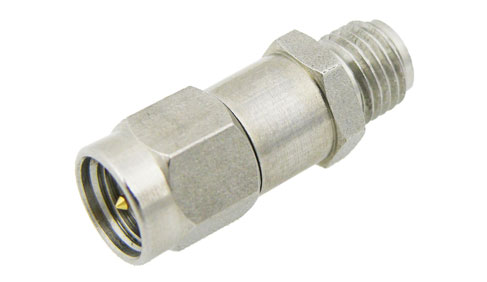
Selecting the right attenuator or termination for 26 GHz operation requires balancing electrical and environmental requirements. Key specifications include connector type SMA and 2.92 mm are the most common at this frequency, and the operating bandwidth, which should cover at least DC–26.5 GHz to ensure full compatibility. Attenuation accuracy is crucial, especially in precision test setups where even small variations can lead to measurement errors. Power handling also matters fixed attenuators must withstand both continuous-wave and peak loads without drifting or degrading.
For terminations, low VSWR and good thermal management ensure that excess RF energy is safely absorbed without reflection. Environmental factors such as vibration, temperature stability, and housing durability are equally important for outdoor or defense applications. Ultimately, the right choice depends on how consistently the component can maintain performance at 26 GHz under the specific demands of your RF system.
26 GHz is a very active chunk of spectrum firmly in the millimeter-wave frequencies. As with many portions of the spectrum and RF components/devices/systems, 26 GHz doesn’t merely refer to the singular frequency of 26 GHz, but the spectrum around that frequency. For instance, there are automotive radar applications at 24 GHz to 24.25 GHz (an ISM band), which some 26 GHz hardware may be suitable for. There are also many other applications, such as Ultra-Wide Band (UWB) that operates from 21 GHz to 26 GHz, that could be considered part of the 26 GHz spectrum, Moreover, 24.25 GHz to 27.5 GHz marks the 5G n258 band (3GPP band n258). Hence, there are a variety of applications operating around 26 GHz where Attenuators and Terminations suitable for 26 GHz could be used.
This means that each individual transmission path at 26 GHz can carry much less signal energy and dissipates more signal energy than lower frequency transmission paths. This is why at 26 GHz, many applications use array antennas, otherwise known as advanced/active antenna systems (AAS). This means that many 26 GHz applications have many transmission paths to provide power and conditioned signals to array antennas, including phased array antennas. Depending on the architecture of the advanced/active array, there may be many transmission paths that require attenuation during testing or use, or terminations during testing/prototyping. This is where 26 GHz attenuators and 26 GHz terminations come into play. These components are vital for use during operation for AAS, but also during the development and testing phases. Attenuators are used to condition the power level of a signal during testing or use and increase the precision of a test by conditioning the output signal energy of a test signal source. Terminations are instrumental in providing impedance match loads at the end of a transmission path to prevent reflections. This is useful during calibration but also when a path may not be used and that signal energy needs to be shunted instead of reflected back to the source.
FAQs (Frequently Asked Questions)
1. Why are 26 GHz attenuators important in RF systems?
A: They regulate signal levels to prevent overload, maintain system linearity, and ensure consistent performance in high-frequency applications like 5G and radar.
2. What do 26 GHz terminations do?
A: Terminations absorb unused RF energy, ensuring proper impedance of matching and reducing reflections that can distort measurements.
3. Can 26 GHz components be used below 26 GHz?
A: Yes, most broadband and maintain stable performance across lower frequencies as well.
4. Where are 26 GHz attenuators commonly used?
A: In 5G FR2 testbeds, mmWave radios, phased-array radar, satellite uplink/downlink systems, and RF labs.
