


Waveguide Power Divider/Combiners Based on Waveguide Magic-T Designs
Key Takeaways
- The Waveguide Magic‑T is a 4-port hybrid waveguide junction that can split or combine RF signals: a signal at the H-plane port divides equally to the two collinear ports (with 3 dB split), while the E-plane port remains isolated; alternatively, two signals on the collinear ports can be combined at the H-plane port, with the E-plane port acting as a difference output.
- Magic-T dividers/combiners retain the advantages of waveguides: very low loss, high power-handling capability, and stable high-frequency propagation, making them especially suitable for microwave, radar, satellite communications, and other high-power RF applications.
- Key performance metrics when using Magic-T-based dividers/combiners include isolation (how well unused ports are isolated from active ones), phase balance (how accurately output signals are phase-aligned), amplitude (power) balance, insertion loss, VSWR/matching, and bandwidth. Deviations from ideal manufacturing tolerances can degrade performance.
- As combiners, Magic-T designs allow combining outputs from multiple amplifiers or sources, commonly used when a single amplifier cannot provide the desired power. This enables efficient high-power transmission in radar, space communication, and phased-array systems.
Why Waveguide Dividers & Combiners Are Critical for High-Power RF and Microwave Systems
Waveguide dividers and combiners play a central role in high-power RF and microwave systems because they offer exceptionally low loss, high power-handling capability, and stable performance across demanding operating conditions. Unlike coaxial splitters, waveguide-based Magic-T structures can manage kilowatt-level power without overheating, arcing, or suffering significant insertion loss. This makes them ideal for radar transmitters, satellite uplinks, electronic warfare equipment, and test environments where signal integrity and reliability are paramount.
By efficiently splitting or combining microwave energy while preserving amplitude and phase relationships, waveguide Magic-T devices support precise beamforming, multi-amplifier combining, and high-efficiency signal routing in applications that operate at high frequencies and high-power levels. Their inherent mechanical rigidity and excellent electromagnetic confinement further enhance stability, ensuring consistent performance even in harsh environmental or mission-critical settings.
Key Performance Parameters: Isolation, Phase Balance, Amplitude Balance, Insertion Loss & Bandwidth
Evaluating a waveguide Magic-T power divider or combiner requires careful attention to several performance parameters. Isolation is essential because it indicates how effectively the device prevents unwanted coupling between ports critical when combining multiple amplifiers to avoid back-feeding or damaging sensitive equipment. Phase balance determines how accurately the device maintains the intended phase relationship (typically 0° or 180°), which directly affects beamforming accuracy, antenna efficiency, and combining effectiveness.
Amplitude balance reflects how evenly power is distributed between output ports; even small imbalances can introduce pattern distortion or power loss in phased array or combining systems. Insertion loss must be minimized to preserve system efficiency, especially in high-power applications where even fractions of a decibel translate to significant power reduction.
Common Challenges & Design Limitations of Magic-T Dividers/Combiners
Despite their advantages, Magic-T waveguide dividers and combiners come up with inherent design challenges and limitations. Achieving perfect isolation between the E-plane and H-plane ports is theoretically ideal but practically limited by mechanical tolerances, surface finish, and assembly alignment. Any small deviation can cause leakage, unwanted coupling, or degraded return loss.
Similarly, maintaining tight amplitude and phase balance across wide bandwidths can be difficult, especially when manufacturing imperfections introduce asymmetry in junction geometry. Magic-T devices are also inherently narrowband compared to some hybrid coupler alternatives, as their performance depends on waveguide dimensions tied to specific TE₁₀ mode propagation characteristics. In high-power scenarios, thermal expansion, flange misalignment, and contamination inside the waveguide can lead to arcing or increased loss.
Waveguides are one of the primary methods of efficiently carrying electromagnetic energy and RF signals from one location to another. Waveguides in particular, are extremely efficient at carrying high power signals with low loss over a considerable length. This is why the waveguide interconnect is still commonly used in high power and precision applications in the spectrum beyond 6 GHz, or millimeter-wave frequencies. As is the case with many sensing, communication, satellite communications, research/development, and test/measurement applications, there is a need to split or combine the signals traveling through different waveguide paths using Waveguide Power Dividers. This can be done with a variety of different types of power dividers/combiners, but one of the most common types is a waveguide Magic-T.
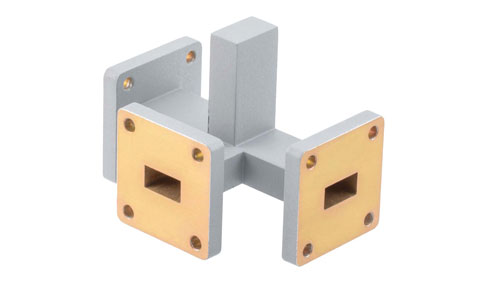
A waveguide Magic-T, or Magic Tee, is a 180-degree hybrid 4-port power divider/combiner made with a monolithic waveguide structure. The Magic Tee design has been around for over 70 years and is a merging of an H-plane waveguide arm meeting with an E-plane waveguide arm at a junction along with two collinear ports. The effect of a Magic Tee is that if two signals are injected into the collinear ports, then the combination of the two signals exit the H-plane port and the difference of the two signals exits the E-plane port. If a signal is injected into the H-plane port then the signals are divided equally to the outputs of the two collinear ports with no energy output at the E-plane port. Lastly, if the signal is injected into the E-plane port then the signal energy is divided between the two collinear ports, except that the signals at the collinear port outputs are 180-degree opposite in phase with no signal energy output at the H-plane port.
This behavior often leads to a nomenclature that calls the H-plane port the Sum port and the E-plane port the Difference port. Ideally, a Magic-Tee has no loss, absolute isolation among the ports, and perfect phase balance among the ports. Given machining tolerances, plating tolerances, etc, there are imperfections in the waveguide power divider/combiner that lead to impedance imbalances (VSWR) among the ports and phase imbalances. These are typically specified as amplitude balance and phase balance between the two collinear ports. There is also loss within a Magic-Tee that is the sum of the power loss between the input port and the output ports of the Magic-T. As a function of the imbalances, there is also inevitably some energy that escapes the E-plane and H-plane ports when they are not intentionally stimulated (isolation).
Frequently Asked Questions (FAQ)
Q1: What is a waveguide Magic-T, and how does it differ from a simple T-junction?
A: A Magic-T is a hybrid 4-port waveguide structure combining an E-plane and H-plane tee. Unlike a simple T-junction, which splits power with impedance discontinuities, Magic-T provides equal power split (or combining), good port isolation, phase control (0°/180° as needed), and minimal reflections, ideal for high-frequency, high-power microwave work.
Q2: What happens when I feed a single input through a Magic-T?
A: If you input a signal into the H-plane port, it is split equally into the two collinear ports (−3 dB each), with negligible energy going to the E-plane port (ideally isolated). The phase between outputs can be controlled depending on the port selection.
Q3: Can Magic-T be used for power combining as well as splitting?
A: Yes. When two signals feed the collinear ports with proper phase and amplitude, the Magic-T can combine them into the H-plane port. This is widely used for combining outputs of multiple amplifiers or sources in high-power applications.
