
All About RF Limiters
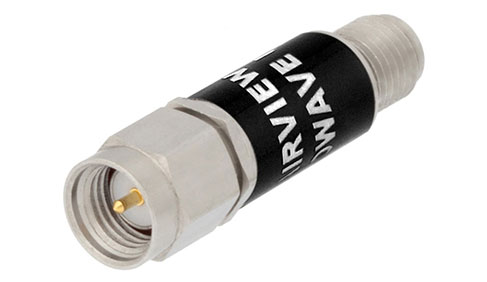
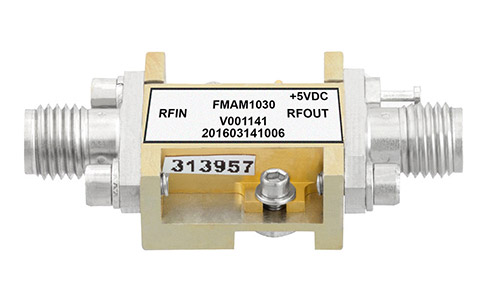
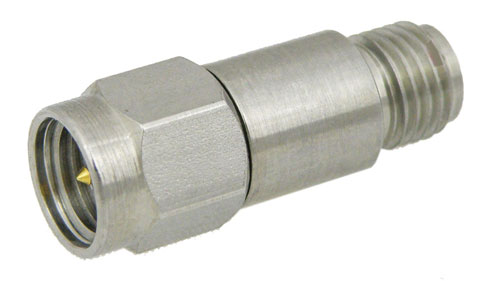
A RF limiter is a two-port, variable attenuation device designed to be used as circuit protection and signal power limiting. The essential function of RF Limiters are, when exposed to signal power above a certain threshold the limiter attenuation is enhanced to ensure that the signal power level at the output of the limiter doesn’t exceed a certain threshold. RF Limiters are designed for a wide variety of applications and use cases, and hence there are a wide range of power levels and styles available, see Broadband High Power Coaxial RF Limiters.
Key Takeaways
An RF limiter is a two-port device designed to protect downstream RF components by limiting signal power when a threshold is reached.
Limiters frequently use PIN-diode or hybrid networks to clamp or absorb excessive RF energy, resulting in fast recovery (often tens of nanoseconds) and low leakage under normal conditions.
Important specs include limiting threshold (the power at which the limiter starts to act), leakage power (power passed when in limit or under threshold), recovery time, frequency span, and power handling (CW, peak) in harsh environments.
Limiters are especially vital in systems with high power transmitters co-located with sensitive receivers, or where unexpected signals/overloads may harm front-end components (e.g., LNAs, mixers).
Proper selection and installation of a limiter significantly enhance system robustness, avoid costly damage, and improves uptime in high-risk RF installations.
One of the most common uses for RF Limiters is at the input of a low-noise amplifier (LNA). As LNAs are designed to amplify very weak signals, they can readily be damaged by unintended high power signal spikes or stray signals. Hence, having an RF limiter in between the antenna and the LNA can help to ensure that the LNA isn’t damaged during high signal transients. However, using an RF Limiter in this way can lead to desensitization of the RF receiver, as an RF Limiter attenuates all signals passing through the device.
As RF Limiters dissipate the excess incident power as heat, an RF Limiter will increase in temperature during use. Use of passive/active cooling measures, such as a heat sink is highly recommended to avoid excessive thermal conditions. RF Limiters may either be terminating/absorptive or reflecting typologies. With reflecting typologies, the excess incident signal energy is reflected instead of absorbed. Another note about RF Limiters is that they are not reciprocal devices, and there is a designated input and output.
RF Limiter Key Electrical Specification Performance Parameters
Frequency range [Hz]
Insertion loss [dB]
Input VSWR
Flat leakage, continuous wave (CW) [dBm]
Spike leakage [joules/nanojoules]
Response time [us]
Recovery time [us]
Input power maximum, continuous wave and peak [Watt]
Limiting threshold [dBm]
Interconnect type/style
When specifying a RF Limiter for an application, it is important to note the flat leakage and spike leakage characteristics. Flat leakage refers to the continuous wave (CW) leakage characteristics, where the spike leakage refers to short transient leakage events, such as pulses or spikes. As many RF Limiters are constructed using diodes, typically PIN diodes, there is a nonlinear response that needs to be taken into account along with the characteristics of the circuit being protected when properly designing or specifying a RF Limiter.
Frequently Asked Questions (FAQs)
Q1. What is the difference between an RF limiter and an RF attenuator?
A: An attenuator continuously reduces signal power by a fixed amount. A limiter allows normal signal levels with minimal loss but switches into a high-attenuation mode when excessive power is detected, protecting downstream components.
Q2. Can an RF limiter protect against all types of signal threats?
A: No—it protects against excessive RF power incidents on a port. It does not replace filters for unwanted frequencies, lightning arrestors for surges, or protections for DC faults. It is one layer in a protection scheme.
Q3. Does a limiter affect system performance under normal conditions?
A: Ideally, a well-specified limiter has very low insertion loss and returns loss under normal operating power, so its impact is minimal. However, insertion loss must still be accounted for in budgets.
Q4. When should I consider using a limiter?
A: Use a limiter when risk of signal over-power exists for co-site transmit/receive, mismatched loads, pulsed radar systems, or when protecting sensitive front ends.
Q5. How do I know if a limiter is failing or if its protection is compromised?
A: Signs include increased leakage power at high incident power, higher insertion loss, unexpected reflections, or damage to downstream components. Periodic testing or monitoring in high-risk systems is advisable.
Q6. Are there different limiter types for different applications?
A: Yes — general-purpose broadband limiters, high-power transmit/receive switch-combined limiters, precision low-leakage limiters for test systems, and rugged MIL-grade modules with extreme environment specs.