


Why Use a Waveguide-to-Coaxial Adapter?
Key Takeaways
- Waveguide to coaxial adapters enable seamless interconnection between low-loss waveguide transmission lines and flexible coaxial cables in RF and microwave systems.
- They provide efficient electromagnetic mode conversion, transitioning signals from the waveguide’s TE mode to the coaxial TEM mode with minimal reflection.
- Proper adapters preserve signal integrity by maintaining impedance matching and low VSWR, which is critical for accurate measurements and reliable system performance.
- These adapters simplify RF system integration, allowing waveguide components to connect directly to standard coaxial test equipment and instrumentation.
- They support a wide range of frequencies, from microwave bands to millimeter-wave applications, depending on waveguide size and connector type.
- Waveguide to coaxial adapters are essential in radar, satellite communications, antenna testing, and laboratory environments, where both high-frequency performance and connection flexibility are required.
Efficient Mode Conversion Between Transmission Lines
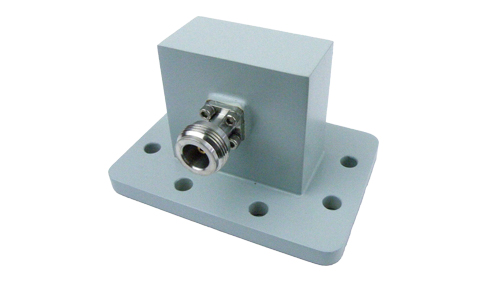
Waveguides and coaxial lines support different electromagnetic propagation modes. Waveguides typically operate in the TE10 mode, while coaxial cables support the TEM mode. A waveguide to coaxial adapter contains a carefully positioned coaxial probe that couples the waveguide field into the coaxial section. The geometry and probe depth are designed to optimize this transition and minimize standing waves that can lead to signal reflection or loss.
Key Benefits of Using Waveguides to Coaxial Adapters
- Improved Signal Transfer: Ensures minimal reflection and maintains impedance match between waveguide and coax.
- Broad Frequency Support: Available for microwave and millimeter-wave bands with precision connectors.
- Reliable Performance in High-Frequency Systems: Suitable for radar, satellite, wireless communications, and lab testing.
Maintaining System Performance and Signal Integrity
One of the primary reasons for using a waveguide to a coaxial adapter is to preserve signal integrity across a complex RF system. A direct, poorly matched transition between different transmission lines can cause reflections, elevated voltage standing wave ratio (VSWR), and degraded power transfer, which negatively impacts overall system performance. Precision-engineered adapters help avoid these issues by maintaining consistent impedance matching, often around 50 ohms.
Waveguides and coaxial assemblies are the most common types of RF interconnect used outside of planar circuit technologies. Both waveguides and coaxial assemblies have their advantages and drawbacks, which is why waveguide to coaxial adapters, as these factors can often lead to both waveguide and coax being used in the same application.
Where waveguides are banded, coax operates from DC to a maximum cut-off frequency. Hence, it is important to remember that a waveguide to coax adapters are also banded by the maximum and minimum cut-off frequencies of the waveguide, or the maximum cutoff frequency of the coax. There are also power limitations in these transitions, which are typically limited by the coaxial interface. This is because waveguides generally have much higher power handling than coaxial transmission lines at the same frequencies of operation.
Waveguide to coaxial transitions are used whenever it is necessary to bridge between a coaxial transmission line environment and a waveguide environment. As waveguides have lower loss than coax, there is often a need to use waveguides where the loss of the interconnect may limit the dynamic range of a sensing or communication system. This is a common situation in test and measurement, radar, and long-range communication systems. These types of transitions are also common when it is advantageous to use waveguide antennas, such as gain horns for antenna testing or for high directivity communications at millimeter-wave frequencies. Other use cases may be based on mechanical or space constraints. Waveguide interconnects are generally larger than coaxial interconnects for the same frequencies, and hence it is often easier to route coaxial interconnects than waveguide. Though flexible waveguides do exist, they exhibit poorer performance than rigid waveguides, and are still larger than coaxial interconnects. This is why coaxial interconnects are often preferred for complex and compact routing scenarios.
However, when high power or low loss is the priority, waveguide interconnects are still preferred. This is why waveguide interconnects will sometimes be used to feed coaxial-based antennas, and Coaxial to waveguide adapters are necessary to enable that transition. There are some cases where legacy equipment may have a waveguide interface, but updated or retrofitted technology up-stream or down-stream to that component may be coaxial. This scenario and other scenarios where it may be preferable to use a waveguide component/device in a coaxial interconnected system or vice versa is another instance where waveguide to coax transitions are useful.
FAQs (Frequently Asked Questions)
1. What is a waveguide for a coaxial adapter used for?
A: A waveguide to a coaxial adapter is used to connect waveguide-based RF components to coaxial cables or test equipment. It enables efficient signal transfer between two different transmission media while minimizing reflections and losses.
2. Why can’t waveguides connect directly to coaxial cables?
A: Waveguides and coaxial cables support different electromagnetic propagation modes. Direct connection would cause severe impedance mismatch, high VSWR, and signal loss. An adapter provides proper mode of conversion and impedance of matching.
3. How does a waveguide to a coaxial adapter affect signal performance?
A: A high-quality adapter maintains low insertion loss and low VSWR, preserving signal integrity, measurement accuracy, and overall system efficiency—especially at microwave and millimeter-wave frequencies.
