


What is a Trihedral Corner Reflector?
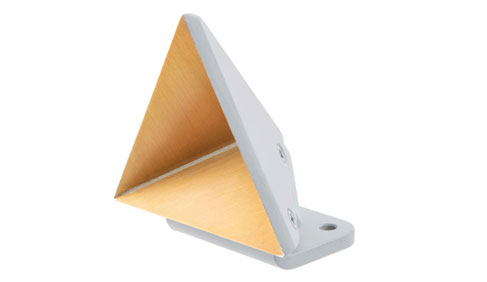
A type of passive radar target or reflector used in many applications, including radar systems, surveying, and communication is called a trihedral corner reflector. The ability to reflect electromagnetic waves, such as radio waves or radar signals, directly back toward the source, regardless of the direction from which the waves approach the reflector is a key characteristic of a trihedral corner reflector.
Key Takeaways
A trihedral corner reflector uses three mutually perpendicular reflective surfaces to redirect incoming radar or RF waves back toward the source via triple reflection. Because of its geometry, trihedral reflectors produce a strong radar return even if the target is relatively small compared with the wavelength, provided the surfaces are large in terms of wavelengths.
Trihedral reflectors serve as canonical, passive radar calibration targets and are essential for RCS measurement, antenna testing, and radar system validation. Design factors such as reflector size, surface finish, mounting stability, and wavelength compatibility strongly influence performance. Trihedral reflectors remain practical and low-maintenance long-term solutions, especially in environments where active targets are impractical or undesirable.
What Is a Trihedral Corner Reflector
A trihedral corner reflector is a passive device made of three mutually perpendicular planar conducting surfaces that meet at a common apex. When electromagnetic waves such as radar or radio signals strike the reflector, they are reflected off each of the three surfaces in turn, and ultimately returned toward the source. This retro-reflection property, where the reflected signal returns roughly along the incoming path, makes the trihedral corner reflector an exceptionally useful tool for radar calibration, antenna testing, range finding, and other applications requiring a well-defined, high radar-cross-section (RCS) target.
Because of its geometry, a trihedral corner reflector produces a strong radar echo even if the incident wave arrives from a wide range of angles, which makes alignment easier and field deployment more tolerant to angular variations.
How It Works — The Principle of Retro-Reflection
When a wave hits the first reflector surface, one component of its direction vector is inverted. On hitting the second surface, the second component is inverted, and on the third surface, the third component is inverted. The cumulative effect is that all three vector components reverse, so the outgoing wave travels back in a direction parallel to but opposite the incoming wave.
Because the structure is symmetric and the reflections are well defined, the returned signal is strong and consistent. As long as the size of the reflector surfaces is large compared with the signal wavelength, the reflector achieves a high effective RCS. That makes even a relatively small trihedral reflector appear as a large target on radar.
Typical Uses and Applications
Trihedral corner reflectors serve as reference targets in radar and antenna testing campaigns. They are widely used to calibrate radar systems, verify antenna patterns, and measure radar cross sections in controlled test-range environments.
They are also used in field environments as passive reflectors for range finding, path validation, obstacle detection, or to provide ground truth returns in experimental radar deployments. Their robustness and simplicity make them ideal where maintenance or power sources are problematic.
Because the returned echo is geometry-based and not dependent on active electronics, trihedral corner reflectors remain reliable over long periods, requiring minimal upkeep beyond ensuring clean reflective surfaces and correct mounting.
Radar testing is a meticulous and complex endeavor. As radars are active systems that rely on the reflections of objects stimulated by the radar signal emitted by the radar antenna. In order to properly calibrate and test a radar, there needs to be a known target behavior to use as a radar system calibration. This is one of the uses of calibrated reflectors or reflector calibration standards.
A trihedral corner reflector is fabricated to high precision to be precisely trihedral and of an exact edge length. Common edge lengths include 1.4 in, 1.8 in, 2.4 in, 3.2 in, 4.3 in, and 6 in. edge lengths. This is a relatively challenging feat of fabrication. The result is a corner reflector that are perfectly matched triangles with equal edge lengths. This structure presents a desirable reflection that is ideal for radar calibration, as these units can be placed at various azimuthal/horizontal angles and distances from a radar. As the reflection is a known pattern, these reflectors can be used to accurately calibrate a radar.
The size of the reflector impacts the radar cross section and the relative magnitude of the reflection that is reflected back to the radar source. This is why various sizes are used. A larger reflector will have a much larger radar cross section and relative magnitude than a smaller reflector. Relative distance or the size of the reflector is one method to control the magnitude of the reflection.
As with any RF calibration hardware, it is critical that the calibration standards remain pristine and are not degraded by environmental factors. This is why it is common to powder coat the outside of the corner reflectors to prevent corrosion. Internally to optimize the corrosion resistance and reflectivity, the insides of corner reflectors are often coated in gold chemical film finish. This type of finish exhibits minimal surface distortions and high conductivity for high reliability and exceptional signal reflectivity. To ensure proper placement of a trihedral corner reflector, it is important to be able to mount these reflectors on a tripod that can allow for precision alignment. Hence, it is common to have reflectors with common threaded holes that fit standard professional tripods.
Recommendations
When selecting or designing a trihedral corner reflector, aim to choose a model with adequate edge length or surface size so the internal dimensions span several wavelengths at your operating frequency. Verify that the internal reflective surfaces use a high-conductivity finish and are free of surface irregularities or corrosion. Use a stable mounting system (tripod or mast) with orientation marking so you can consistently align the reflector with source antennas. For calibration work, document reflector dimensions, orientation, and environmental conditions to ensure repeatability. After field deployment, inspect the reflector surfaces regularly and clean or re-coat if degradation occurs to preserve signal quality.
Related articles
Peter McNeil | Oct 25, 2022 | Antennas
There are a wide range of antenna technologies available today. A more recent option is to choose a multi-input multi-output (MIMO) antenna. Though newer, is a MIMO antenna better than a traditional single-input single-output SISO antenna? More is always better right? This is certainly not the case with SISO and MIMO antennas, and like virtually every RF circuit/signal chain, the antenna is a critical component that needs to be precisely specified for a given application and that decision making needs to include the other devices/components in the system.
A SISO antenna is a single-port antenna that has a single driven element, though the antenna could be balanced or unbalanced depending on the design. A MIMO antenna, on the other hand, is an antenna system that consists of at least two distinct antennas. Each of the MIMO antenna elements has a distinct input port that is designed to be driven individually from a MIMO compatible radio. In theory, a MIMO antenna may be driven like a SISO antenna by splitting the power from a SISO radio to the multiple MIMO antenna elements. However, this likely won’t provide substantial benefit, and an appropriate SISO antenna would probably provide better performance, especially considering the intrinsic losses associated with introducing any passive elements in a signal chain.
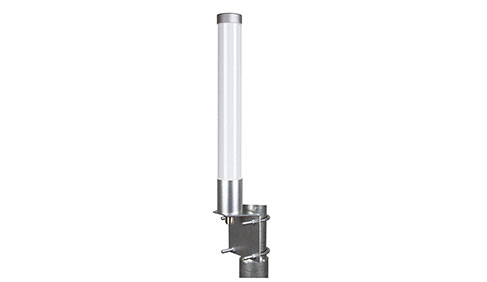
SISO Omni Antenna
In order to make the most of a MIMO antenna, a MIMO radio is needed. This could be a WiFi or cellular system that makes use of MIMO technology and spatial multiplexing to provide higher throughput than is possible with a single spatial channel.
The number of MIMO channels, radio hardware/protocol, and channel quality determines the overall throughput gain possible compared to a SISO antenna system. If the radio hardware/protocol or channel quality is poor, then a MIMO system may not provide any substantial benefit over a SISO system. Hence, knowledge of the channel and radio technology are critical in determining if a MIMO antenna is appropriate. If the application is appropriate and the communication link is between two MIMO-equipped nodes, then it is possible to achieve many times the throughput of a comparable SISO communication link. It is important to note that MIMO isn’t necessarily using different frequency bands to increase throughput but is instead using spatial multiplexing to create separate spatial channels with their own communication stream.
Generally, the only reason to employ a MIMO system is to provide greater throughput, possibly to a larger number of devices in a given region. MIMO systems are intrinsically different and should not be confused with beamforming antenna systems, though an advanced antenna system (AAS) may be both MIMO and beamforming capable.
Peter McNeil | Feb 02, 2026 | Antennas
A Yagi-Uda Antenna (Yagi Antenna), named after the co-inventors Hidetsugu Yagi and Shintaro Uda, is a direction antenna with a single driven dipole section with a series of parasitic elements (directors) that re-radiate energy from the main dipole thus manipulating the antenna pattern. The parasitic elements of a Yagi antenna are within the near field of the main dipole, and hence significantly alter the antenna pattern as compared to a dipole without parasitic elements. The overall effect results in a much more directional antenna pattern, with the antenna pattern being dedicated by the spacing and length of the main dipole and parasitic elements.
Key Takeaways
A Yagi-Uda antenna uses a driven element plus parasitic elements (reflector and directors) to focus radio energy in a chosen direction. The reflector boosts forward gain by suppressing backward radiation, and directors further narrow the beam and increase forward gain.
Each additional director contributes diminishing returns in gain increase. High-gain Yagis tend to have narrow bandwidth, require precise element spacing and mechanical support, and often need impedance matching for proper feedline connection.
The front-to-back ratio is an important metric for interference rejection, but designing for a high F/B ratio may conflict with maximizing forward gain or bandwidth. Yagi antennas excel in fixed, directional, and narrowband scenarios such as point-to-point links, rural connectivity, broadcast reception, and amateur radio.
What Is a Yagi-Uda Antenna
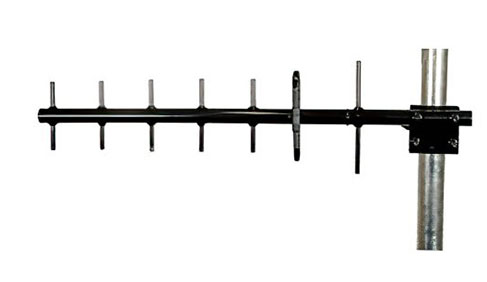
A Yagi-Uda antenna (commonly called a Yagi) is a directional antenna that uses a driven dipole element plus a set of parasitic elements (a reflector and one or more directors) to shape its radiation pattern. The parasitic elements are not electrically connected to the feedline. Instead, they receive energy from the driven element and re-radiate it in controlled ways so that radiation in one direction is reinforced and radiation in other directions is canceled or reduced. This arrangement transforms an omnidirectional dipole-like pattern into a directional beam.
How the Number of Elements Affects Yagi Performance
Increasing the number of parasitic elements directly influences the Yagi’s gain, directivity, and beamwidth. More directors generally lead to higher forward gain and a narrower radiation pattern, making the antenna more directional.
Impact on Gain and Beamwidth
Each additional director typically adds a small amount of forward gain—usually around 0.5 to 1 dB—while also narrowing the beamwidth. This increases the antenna’s ability to focus energy and reject signals from undesired angles.
Diminishing Returns with Additional Directors
After a certain point, adding more directors yields minimal gains and improvements while increasing mechanical complexity. Beyond roughly 10–15 elements, physical size grows significantly, but performance improvements become marginal.
Directional Yagi Antenna
Yagi Antennas are a type of fixed antenna and are often mounted on a mast or pole and can be used indoors or outdoors depending on their IP rating. Some examples of Yagi Antennas include the FMANLP1005 Yagi Antenna which operates in the 5 GHz band to provides highly focused directional connectivity. The FMANLP1010 Yagi Antenna offers 14 dBi of gain along with vertical polarization and operates in the 3 GHz band to address 5G, LTE, CMDA, LoRA, IoT, WIFI applications.
A Yagi antenna also typically has a reflector section positioned “behind” the driven dipole element to further aid in increasing the directivity of the antenna. The reflector is often a series of conductive shafts, or mesh, typically about 5% longer than the driven element, and can consist of one or more shafts spaced “behind” the driven element. The reflector may also wrap around the “sides” or “top” and “bottom” of the Yagi antenna to further concentrate the antenna radiation in the forward direction.
The impact of the reflector is to increase the gain in the forward direction by reducing the radiation in the reverse direction of the antenna and focusing that radiation instead in the forward direction of the antenna (adds around 4 or 5 dB of gain to the forward direction. Though careful design can largely reduce sidelobe development, sidelobes are still developed that reduce the overall gain of the Yagi antenna.
The directors also add gain in the forward direction, by capturing and re-radiating the radiation that would otherwise spread out in a dipole antenna pattern. In this way, the Yagi antenna gain is a function of the number of directors added to the front of the antenna. There is a point at which the benefit to gain of designing in additional direction begins to diminish, with a maximum Yagi antenna gain limited to around 20 dB for a single antenna. By adding more directors the beamwidth of the Yagi antenna narrows along with increasing gain, which results in a practical limit for certain applications.
Moreover, the spacing and size of the Yagi antenna directors and mechanical structure to support the antenna structure results in a practical limit for the gain and directivity of low frequency Yagi antennas. This is due to the larger spacing and director lengths needed for efficient operation at lower frequencies. Hence, high gain Yagi antennas with high directivity are also naturally long antennas. A common figure-of-merit for a Yagi-Uda antenna is the front-to-back ratio. This is simply a ratio of the antenna radiation in the forward direction of the antenna and the reverse direction of the antenna, often expressed in a log ratio (dB).
The bandwidth of a Yagi antenna is also a function of the size of the Yagi antenna, namely the length, diameter, and spacing of the elements. Yagi antennas typically have a maximum percent bandwidth that is a few percent of the designed center frequency. The number of elements also reduces the bandwidth of a Yagi antenna, so a higher gain Yagi antenna also has a narrower bandwidth along with higher directivity. Therefore, when designing a Yagi-Uda antenna, there are generally trade-offs with the key performance parameters of gain/directivity, frequency of operation, bandwidth, size, and front-to-back ratio.
Explore our wide range of RF Antennas.
FAQs (Frequently Asked Questions)
Q1: What makes a Yagi antenna directional?
A: The driven element works with parasitic elements that reradiate energy in a way that reinforces forward radiation and reduces backward energy.
Q2: How does the front-to-back ratio affect performance?
A: A higher ratio improves rejection of interference coming from behind the antenna, which is useful for crowded RF environments.
Q3: How many directors should a Yagi have?
A: Adding more directors increases the gain but with diminishing improvement. Practical designs balance gain with mechanical size and bandwidth.
