


What Is a Broad band Amplifier?
Key Takeaways
- A broadband RF amplifier is designed to provide gain over a wide frequency range (often spanning several octaves), rather than being tuned to a narrow frequency band. These amplifiers are ideal for applications where signal chains must handle variable or wideband signals, such as broadband communications, radar, satellite links, wideband test equipment, or multi-band receivers.
- Broadband amplifiers can offer significant gain and relatively flat response across a wide band, but like all designs, they involve trade-offs: wider bandwidth often comes at the cost of higher noise, flatter gain requires careful design, and linearity or power handling may be limited.
- Performance parameters to check include gain, gain flatness (variation across bandwidth), noise figure, linearity (IP3, P1dB), input/output matching (VSWR/impedance), and power handling.
- Selecting the right amplifier depends on application requirements: whether you need low-noise amplification, wide-bandwidth coverage, moderate power output, or stable gain; each use case has different ideal amplifier characteristics.
How Broadband Amplifiers Work Key Design Considerations
Broadband amplifiers work by maintaining consistent gain across a wide frequency span, often extending over several octaves. To accomplish this, designers rely on broadband matching networks, distributed amplifier topologies, and wideband transistor technologies such as GaAs, GaN, or InP. Unlike narrowband amplifiers, which use tuned LC circuits optimized for a single frequency, broadband designs must minimize frequency-dependent impedance variations across the entire spectrum. Key design considerations include achieving stable input/output matching to maintain low VSWR, preventing gain roll-off at band edges, and ensuring device stability under varying load conditions. Thermal management and biasing are also critical because broadband devices frequently drive wide dynamic ranges and multiple modulation schemes without distortion.
Key Performance Metrics: Gain, Gain Flatness, Bandwidth, Noise & Linearity
Evaluating a broadband amplifier requires looking at several performance metrics that directly affect system-level behavior. Gain indicates how much the amplifier boosts the input signal, while gain flatness describes how consistently that gain is maintained across the full operating band — a key requirement for wideband receivers, test equipment, and multi-band radios. Bandwidth defines the continuous frequency span over which the amplifier can operate effectively.
Noise figure (NF) is especially important in low-noise or sensitive applications, as it determines how much additional noise the amplifier introduces to the signal. Linearity measures such as IP3 and P1dB indicate how well the amplifier handles large or complex modulated signals without distortion, compression, or intermodulation. Together, these parameters determine whether a broadband amplifier can support high dynamic range, low-noise front ends, linear transmit paths, or precision measurement systems.
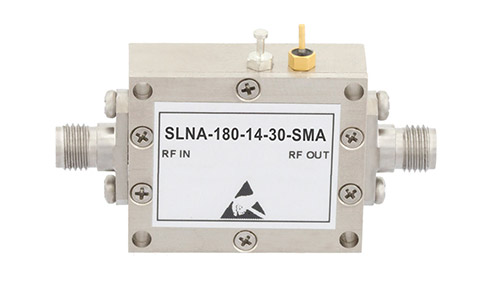
There are many cases in RF signal chains where it is necessary to increase the power level in a signal. For broadband or wideband systems that may cover up to several frequency octaves, a Broad band Amplifier is needed. This type of amplifier is designed to operate over a wide frequency range and introduce minimal noise and distortion to the signal while providing some gain. Typically, broad band RF amplifiers are used at key sections of a signal chain that require wide bandwidth but are not specifically areas where low-noise amplifiers or high gain amplifiers are used. The broad band amplifier differs from gain-block amplifiers mainly by their designation as having a wider bandwidth.
This nomenclature is somewhat cumbersome and confusing as there are also wideband or broad band low-noise amplifier and power amplifier variants that could be used in similar ways as broadband RF amplifiers. Many modern RF systems operate over wide bandwidths and are hence “broadband” which may add some confusion. There is no standard designation for what “broadband” or “wideband” mean in a general sense in terms of RF nomenclature. In cellular and home internet services, broadband is used to designate an approach that achieves better data transmission speeds for users as the signal bandwidths are larger than legacy services. One communications definition for wideband is a message bandwidth that exceeds the coherence bandwidth of a channel. The coherence bandwidth can be defined as the frequency range for which a channel has a flat amplitude response, or over which the amplitude fading is comparable. To what degree of “comparability” or “flatness” for these figures across a frequency range depends on the technological capability and is hence a moving target.
These amplifiers may be designed for a specific range of applications, such as a portion of the spectrum typically dedicated to a certain type of radio use case or as a generic equipment that covers an extremely wide frequency range. An example of this is a 2 GHz to 6 GHz Medium Power Broad band Amplifier, which is likely intended or used as an amplifier for cellular or WiFi applications to 6 GHz. Another example is the 2 to 18 GHz Medium Power Broadband Amplifier, which covers a much wider frequency range and could be used for cellular, WiFi, UWB, satellite, radar, or any other application within that frequency range.
Broadband RF amplifiers can be made to provide a significant amount of gain or can be made to exhibit a very low added noise figure. There are typically tradeoffs with amplifier designs among bandwidth, gain, gain flatness, added noise figure, nonlinearity, and power use. Hence, a broadband amplifier with a given design feature that is exaggerated may have less performance in other categories. More expensive amplifier designs and materials also exist that address some of these typical limitations by using more costly design techniques, materials, or fabrication methods.
Recommendations for Choosing and Using Broadband RF Amplifiers
First, define your required frequency range. Choose an amplifier whose specified bandwidth fully covers it, with a margin for any expected expansion. Evaluate gain and gain flatness across the band to ensure stable performance and minimal variation across frequencies.
Check noise figure and linearity (IP3 / P1dB) if your application involves weak signals or high dynamic range. For wideband systems that span many GHz, prefer modules with broad flat gain, stable VSWR, and robust connectorization.
If your system requires a high-power output (e.g., for transmission, uplink), verify the power-handling rating and consider thermal, supply, and linearity limits before deployment.
Always match 50 Ω impedance and ensure proper input/output matching to avoid reflections or losses.
