


What Are RF Adapter Kits and What Are They Used For?
Key Takeaways
- RF adapter kits provide ready-to-use combinations of coaxial adapters for connecting different RF connector types.
- They support diverse applications from test and measurement to maintenance and troubleshooting.
- Adapter performance is defined by connector quality, minimal insertion loss, and low VSWR.
- By simplifying connectivity challenges, adapter kits improve workflow efficiency and protect valuable instrument connectors.
What Is an RF Adapter Kit?
An RF adapter kit is a curated set of radio frequency (RF) adapters designed to interconnect different coaxial connector types within RF and microwave systems. Instead of sourcing individual adapters, engineers and technicians use adapter kits to quickly resolve connector mismatches during testing, prototyping, installation, or troubleshooting. These kits typically include commonly used interfaces such as SMA, N-Type, BNC, TNC, 2.92 mm, and 3.5 mm connectors, allowing seamless compatibility between instruments, cables, antennas, and devices operating across a wide frequency range. RF adapter kits help minimize downtime, reduce the risk of connector damage, and improve workflow efficiency in lab and field environments.
How RF Adapter Kits Work in RF & Microwave Systems
RF adapter kits function by providing mechanical and electrical transitions between incompatible connector types while maintaining impedance continuity, typically at 50 ohms. When integrated into an RF or microwave signal chain, adapters enable signals to pass between components without significant reflection, insertion loss, or degradation. In test and measurement setups, adapter kits allow engineers to rapidly reconfigure signal paths as equipment changes, ensuring signal integrity across frequency bands. High-quality RF adapters in these kits are precision-machined to support consistent VSWR performance, making them essential for applications involving high frequencies, wide bandwidths, and sensitive RF measurements.
There are many situations in the laboratory, automated setup, and field where RF coaxial adapters are extremely useful for mating between different coaxial connector types. Installation or test environments where there is a mix of several coaxial connector types is where RF adapter kits shine. An RF Adapter kit is simply a series of RF coaxial adapters that are selected to mate between several key coaxial connector types.
An RF coaxial adapter is simply two coaxial connectors precisely assembled around a common housing with the both center conductors and outer conductors attached. Ideally a coaxial adapter will have minimal insertion loss and very low VSWR. There are high precision coaxial adapters that are generally made for test and measurement applications and offer extremely low insertion loss and VSWR. This is important for test and measurement applications, as any added insertion loss and VSWR can reduce the dynamic range of the overall test system. There are also other specialty RF adapters that include weather seals, are positioned at right angled, are radius right angled, are designed for bulkhead fixturing, or others.
Typically, RF Adapter Kits are combinations of adapters that are commonly used alongside each other. For instance, with millimeter-wave applications, 1.85 mm, 2.4 mm, and 2.92 mm coaxial connectors are very common. Hence, an RF Adapter Kit for millimeter-wave applications will likely include 1.85 mm RF Adapters, 2.4 mm RF Adapters, 2.92 mm RF Adapters, and possibly even 1.0 mm RF Adapters depending on the maximum frequency of the millimeter-wave system.
It is also common to see 3.5 mm and SMA adapters used in many test and measurement applications alongside N-type and BNC adapters. This is because SMA, N-type, 3.5 mm, and BNC are some of the most common coaxial connector types for frequencies below 18 GHz. 3.5 mm coaxial connectors are generally rated to 26.5 Ghz, with a maximum theoretical operating frequency of 34 GHz, however, a coaxial adapter is limited in frequency to the lowest maximum frequency between the two coaxial connector types.
It is also common to have RF adapter kits that are designed to mate between push-connect type coaxial connectors and threaded coaxial connectors for test and measurement applications as well as troubleshooting/maintenance. For example, MCX Adapters that mate to SMA, N-type, BNC, or 3.5 mm are often used for board mount push-connect MCX connectors that are either surface mount or end-launch. These types of low-cost and compact push-connect type connectors are often found on RF and high-speed digital circuit boards as test ports, which is why in quality/verification or rework stations, RF Adapter kits with push-connect to threaded coaxial connector types are very useful.
FAQs (Frequently Asked Questions)
Q1: What is included in an RF adapter kit?
A: An RF adapter kit typically includes adapters for commonly paired connectors like SMA, N-type, 3.5 mm, BNC, and mmWave connectors.
Q2: Can RF adapters affect signal quality?
A: Yes, high-quality RF adapters have low insertion loss and low VSWR to preserve signal integrity; poor adapters can introduce reflections or added loss.
Q: Do adapter kits work for millimeter-wave applications?
A: Yes, specialized kits include mmWave adapters (e.g., 1.85 mm, 2.4 mm) suitable for high-frequency links.
Related articles
Peter McNeil | Aug 24, 2022 | Custom Cable Configurator
The Fairview The RF Cable Designer™ is an extremely useful tool for ordering custom coaxial cable assemblies. Instead of having to email or call a technical sales representative to order a specific custom cable assembly, a user can now simply input their desired custom cable parameters and order their cable online. The custom coaxial cables ordered this way usually ship the same day as ordered. Moreover, all of Fairview’s custom cables ordered this way have single heat shrink installed by default at no additional cost.
Using The RF Cable Designer™ is quick and straightforward. Just follow these steps:
- Select your desired Connector 1, Connector 2 & Coax Cable parameters in any preferred sequence.
- The checkboxes next to the parameters change their status dynamically based on your selections:
- Click on the parameter checkbox to lock the value from changing.
- Ensure there is no checkbox unselected (white color) next to each Connector and Cable parameter.
- Select any additional “Assembly Options”.
- Click “Create My Cable Assembly” to proceed to your custom cable’s product page.
- On the product page, enter your desired cable length, review pricing & details, then place your order.
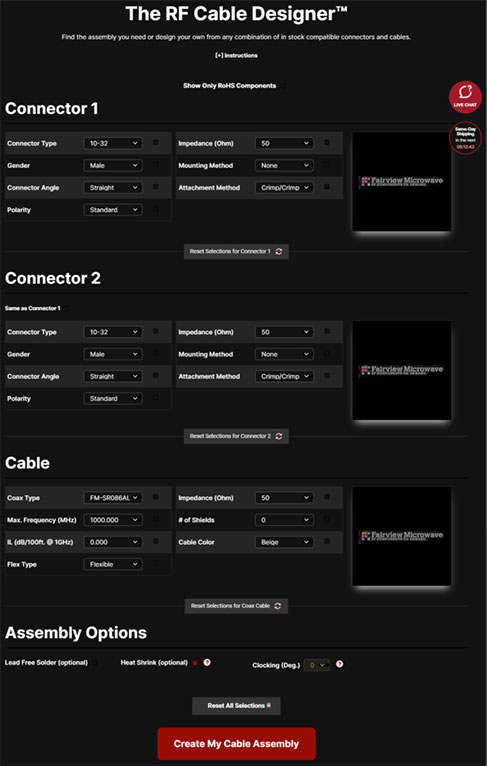
The Fairview RF Cable Designer™ interface
Once an option field is selected and the “lock-in” button is selected, then the remaining customization options that are not compatible with the already locked-in parameters will no longer be selectable. If there is only a single result for a given option, the parameter selection drop-down menu will be grayed and unselectable as will the “lock-in” button.
An important Assembly Option to note is clocking. If multiple right-angle connectors are selected then the clocking becomes essential. A right-angle connector can be clocked at either 0, 90, 180, or 270 degrees as indicated in the following image. This is especially significant for semi-rigid or rigid coaxial cable, as the clocking won’t be adjustable after ordering.
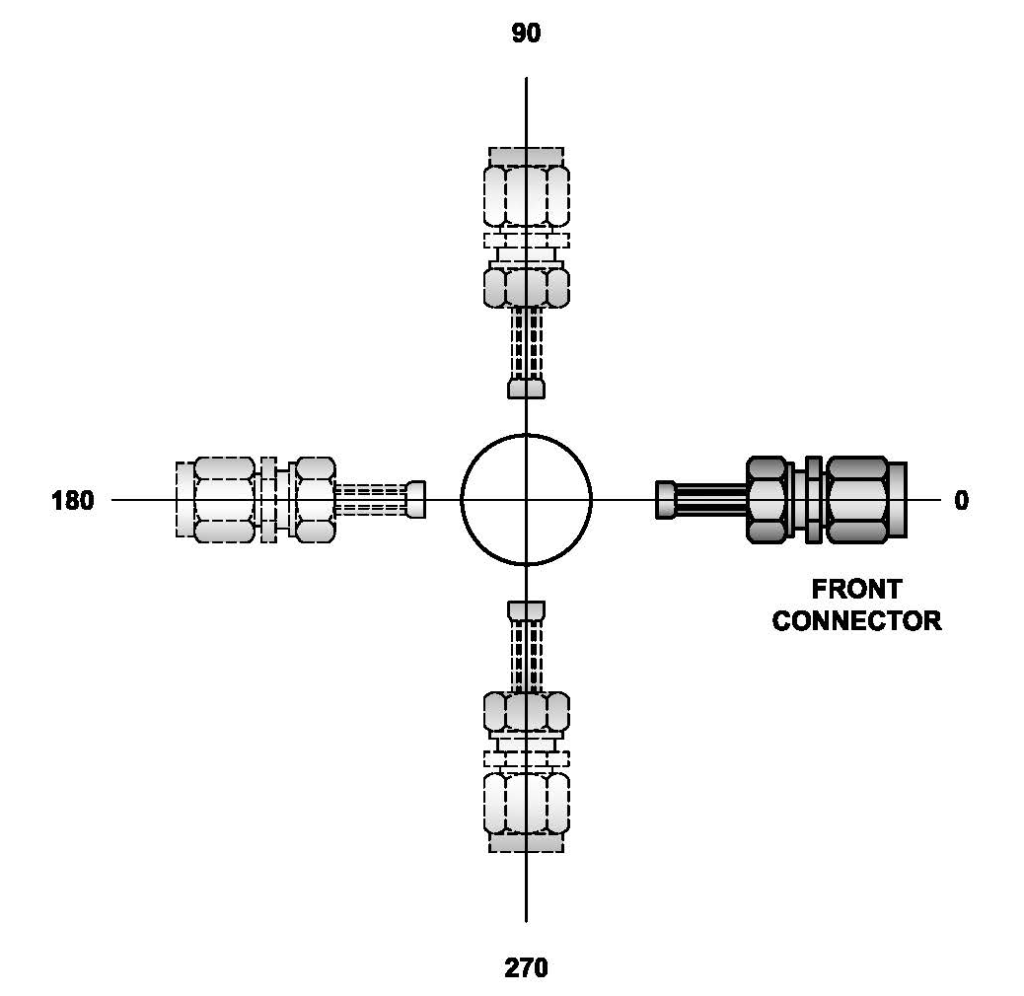
Right angle coaxial cable assembly clocking diagram.
Once all of the parameters are selected and locked-in, the large “Create My Cable Assembly” button on the bottom will become functional. If all of the parameters are not selected and the button is clicked, a popup indicating that all the parameters have not been selected will appear.
After successful custom coaxial cable selection occurs a web page will be created for the supplied configuration with a distinct product ID. Now the length and quantity of the custom coaxial cable assemblies can be chosen. Once the “calculate” button is clicked then the pricing for various quantities will appear and an input field denoting the quantity desired will appear along with the “Add to Cart” button.
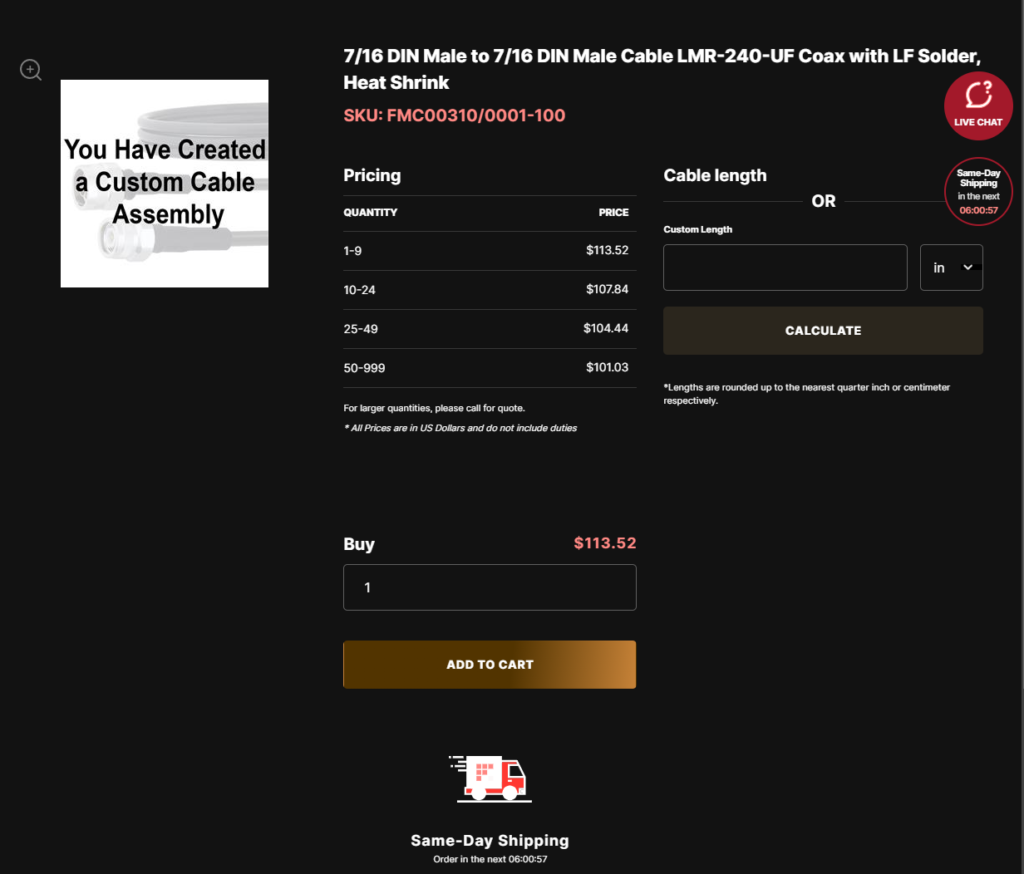
Custom coaxial cable assembly web page
