
Use Case Discussion For 50 GHz High Power RF Fixed Attenuators (2.4 mm Coaxial Connectors)

Key Takeaways
- 50 GHz high-power RF fixed attenuators are essential for millimeter-wave systems, supporting applications well beyond traditional microwave frequencies.
- Precision 2.4 mm connectors enable reliable electrical performance, low VSWR, and controlled impedance at frequencies up to 50 GHz.
- These attenuators play a critical role in protecting sensitive RF components from excessive signal power.
- Fixed attenuators help improve impedance matching and reduce standing waves in high-frequency signal chains.
- Common use cases include test & measurement, radar systems, satellite communications, phased arrays, and 5G/6G development.
Why 2.4 mm Connectors Are Used for 50 GHz Fixed Attenuators
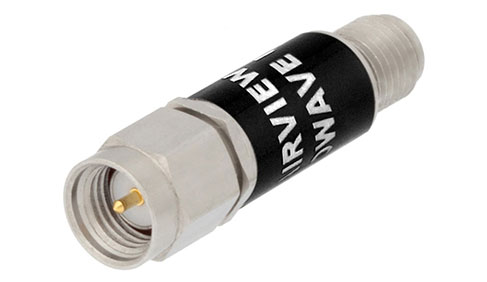
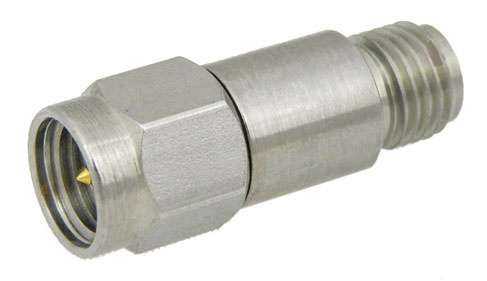
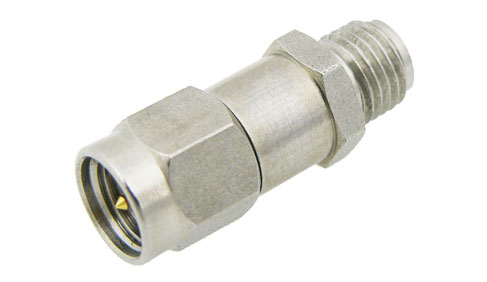
The 2.4 mm coaxial connector is a precision microwave connector designed to support extremely high frequencies, often up to 50 GHz and beyond, while maintaining controlled impedance and minimal VSWR. Its rugged design also supports stable mechanical performance in demanding environments, making it ideal for high-frequency attenuators used in development, test, and integration.
This type of attenuator typically features:
- Broad frequency coverage up to 50 GHz
- Precise attenuation values for predictable signal conditioning
- High average power handling compared to lower frequency connectors
- Low VSWR and good return loss across the operational band
Common Environments Where 50 GHz Attenuators Are Used
Radar & Sensing Systems: Millimeter-wave radar applications such as automotive, aerospace, or security sensing often operate well into the 20–50 GHz range. Fixed attenuators help tune signal levels in both development and deployment phases.
Satellite Communications: High-frequency satellite links (especially Ka-band and beyond) require components that can handle wide bandwidths with precise signal conditioning. Fixed attenuators are part of the RF chain for calibrating and testing these systems.
High-Frequency Telecom & 5G/6G: Emerging cellular standards and back-haul technologies are expanding into millimeter-wave bands, increasing the need for high-frequency attenuators in both test labs and field deployments.
Lab & Automated Test: Fixed attenuators with calibrated attenuation values are indispensable in test and measurement, RF calibration setups, and automated test workflows where repeatability and accuracy are critical.
As the concerns for spectrum cluttering persist in the sub-6 GHz frequency range, there is a greater demand for new applications and stifled applications to shift toward higher frequencies. The most accessible frequencies for many applications beyond 6 GHz are between 20 GHz and 50 GHz. This is due to spectrum assignments for military radar/sensing and satellite communications between 8 GHz and 18 GHz (the X-band and Ku-band). There are also many commercial satellite communication systems that are becoming more available that operate between 18 GHz and 40 GHz (the K-band and Ka-band). Many telecommunication organizations and government spectrum regulatory agencies are also working toward opening up additional spectrum between 20 GHz and 50 GHz available for cellular wireless communication and other applications.
With the rise of technologies being explored in the spectrum up to 50 GHz, there is a need for devices and components to test and develop these systems, as well as components and devices used in production of these new technologies. This is why there is a growing demand for test and system components like 2.4mm Coaxial Fixed Attenuators. The relatively small geometry of coaxial transmission lines that can operate to 50 GHz and the high conductive and dielectric losses in the millimeter-wave frequencies mean there is a scarcity of high-power millimeter-wave systems at these frequencies. However, to test high power amplifiers, antenna systems, and other hardware at these millimeter-wave frequencies high power test components are needed. Fixed attenuators at various values are critical for performance of a variety of measurements, and to reduce the standing waves developed between nodes with some impedance mismatch. Fixed attenuators may also be used to adjust the attenuation of the transmission lines in systems that have several signal paths, so that the signal strength at the ports is equalized. Phase shifters may also be used in this application so that the phase and amplitudes of the several transmission paths are all equalized.
These types of use cases are becoming more common as many systems in the millimeter-wave spectrum are making use of advanced/active antenna systems (AAS) with several, tens, and even hundreds of transmission paths to the array antennas. These types of systems are used in terrestrial and satellite communications. Moreover, advanced radar and millimeter-wave sensing systems use similar AAS technology. Hence, the need for a wide range of 2.4 mm coaxial fixed attenuators is growing as efforts are made to increase the utilization of spectrum above 6 GHz.
FAQs (Frequently Asked Questions)
Q1: What is a 50 GHz RF fixed attenuator?
A: A 50 GHz RF fixed attenuator is a passive coaxial device designed to reduce RF signal amplitude by a fixed amount while maintaining impedance stability at frequencies up to 50 GHz.
Q2: Why are 2.4 mm connectors used for 50 GHz attenuators?
A: 2.4 mm connectors are precision-engineered to support extremely high frequencies with low insertion loss and minimal reflection, making them ideal for mmWave applications.
Q3: What applications require high-power RF fixed attenuators?
A: High-power attenuators are commonly used in radar systems, satellite communications, automated test equipment, high-frequency telecom infrastructure, and laboratory testing.