
The Basics of Fixed RF Attenuators
Key Takeaways
- A fixed RF attenuator is a passive device that reduces signal amplitude by a set amount (in dB), useful wherever the incoming signal is stronger than what downstream equipment can handle.
- Besides lowering signal power, attenuators help improve impedance matching and reduce standing waves caused by impedance mismatches, which can otherwise degrade signal integrity.
- Fixed attenuators come in various interconnect types: coaxial, waveguide, surface-mount (planar), or even bare-die designs making them versatile across many RF system architectures.
- Key specs when selecting an attenuator include frequency range, attenuation value, insertion loss, VSWR, impedance, power handling (CW/peak), connector type, and thermal/temperature ratings.
- High-power applications may require attenuators with thermal management from simple metal housings to heatsinks or active cooling to safely dissipate absorbed signal energy.
What Is a Fixed RF Attenuator & Its Core Purpose
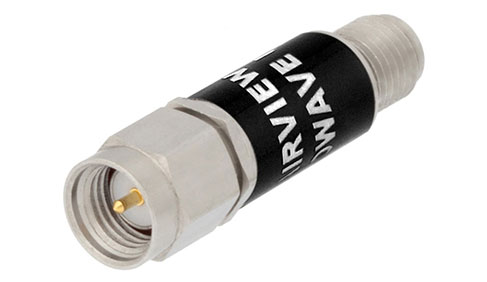
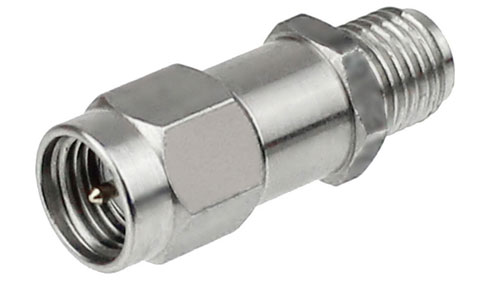
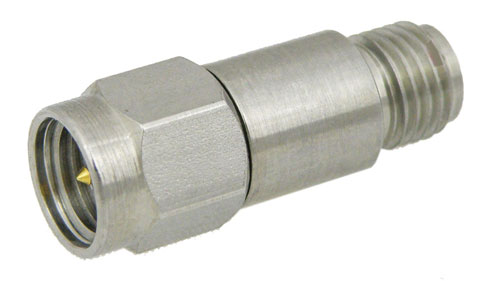
A fixed RF attenuator is a passive component designed to reduce the power level of an RF signal by a specific, pre-set amount. Instead of amplifying or shaping the signal, it simply weakens it in a controlled and predictable way, typically expressed in decibels (dB). This makes attenuators essential anytime the input signal is too strong for a downstream device, such as a receiver, mixer, LNA, or test instrument. Beyond reducing signal amplitude, fixed attenuators also help improve impedance matching between components.
When equipment with slightly mismatched impedances is connected, reflections and standing waves can occur, causing distortion and measurement of inaccuracies. By inserting an attenuator, those reflections are dampened, leading to cleaner signal transmission and more stable system behavior. In short, the core purpose of a fixed RF attenuator is to protect sensitive components, optimize system performance, and maintain consistent signal flow.
Key Specifications to Consider Before Choosing an Attenuator
Selecting the right fixed RF attenuator requires close attention to a few essential technical parameters. The first is the attenuation value, which dictates how much the signal will be reduced. Common values include 3 dB, 6 dB, 10 dB, and 20 dB. Next is the frequency range, which must fully cover your system’s operating band to avoid performance roll-off. Power handling is another critical factor: attenuators must safely dissipate the RF energy they absorb, especially in high-power or continuous-wave systems.
Equally important is VSWR, a measure of how effectively the attenuator maintains impedance matching; lower VSWR values lead to fewer reflections and more accurate system performance. Connector type also matters, as the attenuator must physically and electrically integrate with your coaxial or waveguide infrastructure. Lastly, in demanding environments, consider thermal stability, temperature ratings, and mechanical durability, which can significantly affect long-term reliability.
Typical Use Cases — When and Why You Use Fixed Attenuators
Fixed RF attenuators are used in a wide variety of RF and microwave systems because they solve multiple signal-level and impedance challenges. In test and measurement environments, attenuators help prevent sensitive instruments—like spectrum analyzers, SDRs, and network analyzers from being overloaded by strong signals. They are also essential for calibrating systems, simulating weak-signal conditions, and creating controlled test environments. In communication systems, attenuators help optimize transmitter-to-receiver links, maintain proper gain distribution, and balance multi-carrier or multi-antenna setups. They’re also used in radar, satellite, and 5G applications to manage power levels during development and field testing.
RF circuits useful for lowering signal amplitude by absorbing a fixed amount of RF energy are called fixed RF attenuators. These devices are also used for dissipating excess signal energy, enhancing impedance matching between two components/devices by lowering the standing waves created by impedance mismatch, and as part of more complex electronic protection for sensitive components. The main use of fixed RF attenuators is for signal level conditioning, typically when the range of input signal energy is known and is greater than that of the desired signal energy at the port attached to the attenuator.
An RF fixed attenuator is specified as a signal attenuation value over a range of frequencies. These attenuators are simple resistive circuits designed to present a nominal impedance at the input and output and may be balanced or unbalanced depending on if the attenuator is meant for balanced transmission lines or balanced transmission lines. Attenuators are made for a variety of different interconnect types, such as coaxial, twisted pair, waveguide, surface mount technology (SMT) as part of planar transmission lines/waveguide (microstrip, stripline, coplanar waveguides, etc.), or as bare die. RF fixed attenuators for waveguide are fabricated differently than coaxial or SMT attenuators with discrete resistive components, often as a waveguide packed with RF absorbing materials.
Key Fixed RF Attenuator Performance Specifications
- Frequency range [Hz]
- VSWR [ratio]
- Insertion loss [dB] *lowest attenuation value
- Attenuation value(s) [dB] *sometimes given over frequency
- Impedance [Ohms]
- Velocity of propagation [%c]
- Power handling (CW, peak) [Watts]
- Attenuation accuracy [+/-dB]
- Interconnect (Connector type 1 and 2 for coaxial, waveguide flange type for waveguide, SMT, etc.)
- Temperature range of operation [deg C]
- Thermal management (heat sink capability, active/passive)
RF attenuators are typically selected based on their attenuation level, frequency range, and power handling capability. In some applications the accuracy of the attenuation is very important, such as test/measurement, metrology, and precision sensing. In other applications, the power handling is most critical. RF fixed attenuators made for high RF power handling applications often include passive or active thermal management. This can be as simple as a metallic housing, a heatsink, a heatsink with active air cooling, or even as a liquid cooled system.
Fixed RF attenuators are foundational elements used throughout the RF industry for test and measurement, sensing, communications, and in virtually every environment RF technology is used. There are RF fixed attenuators available that meet the wide variety of automotive, aerospace, space, naval/maritime, applications.
Frequently Asked Questions (FAQs)
Q1: What does a fixed RF attenuator do?
A: A fixed RF attenuator reduces the amplitude of an RF signal by a fixed amount (e.g., 3 dB, 6 dB, 10 dB), ensuring that downstream components receive a safe and manageable signal level. This helps prevent overload and distortion.
Q2: Why not just use a cable or amplifier with lower power instead of an attenuator?
A: Because an attenuator does not just reduce power, it maintains proper impedance matching and minimizes reflections, which cables or mismatched amplifiers alone may not do reliably. This improves signal integrity and stability in the chain.
Q3: In what situations are fixed attenuators typically used?
A: They are widely used in test & measurement setups, communications systems, receiver protection, antenna testing, and anywhere signal levels need to be controlled, or impedance mismatches mitigated.