
Why the N-Type Connector Still Matters
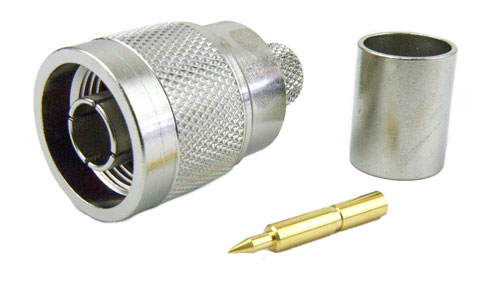
N-type Coaxial Connectors are one of the most common coaxial connector types used in wireless communication and sensing systems. This connector type has been around since the 1940s and was originally designed for military applications not exceeding 1 GHz maximum operating frequency. These coaxial connectors can be found in virtually all applications that operate below 6 GHz, though there are such connector variations that go as high as 11 GHz or even 18 GHz. N-type coaxial connectors are typically threaded connector types, though there are several variations, as there are with another common coaxial connector type, the SMA connector. N connectors were originally defined in MIL-STD-348 and come in both 50 Ohm and 75 Ohm versions. This is sometimes an issue as many manufactured versions of these connectors are not labeled as either 50 Ohm or 75 Ohm, and may be confused in broadcast, military, automotive, and other applications that may use both 50 Ohm and 75 Ohm N-type connectors, which are not typically compatible.
Key Take-away
The N-type connector is a threaded, weather-proof, medium-size RF coaxial connector that supports broadband frequencies (commonly up to ~11 GHz; extended versions go higher).
It exists in both 50 Ω and 75 Ω impedance versions, so matching impedance is critical to avoid mismatch and performance issues
Because of its robust construction, N-type is widely used in rugged or outdoor environments, e.g., telecom base stations, antenna feeders, and microwave systems.
Key performance parameters include VSWR (or return loss), insertion loss, power handling (which drops as frequency increases), and mechanical durability (mating cycles, weather resistance).
Installing N-type connectors properly (correct torque, proper cable preparation, using compatible cable and cable impedance) is just as important as selecting the correct connector type—poor installation undermines performance.
While newer, smaller connector types exist for high-frequency or compact applications, N-type remains a reliable choice for many systems where moderate size, ruggedness and cost-effectiveness are required.
Like other coaxial connectors, there are female and a male N-type coaxial connectors, though there are hermaphroditic connector variations also available. These are less common than the typical threaded type, as hermaphroditic connectors tend to be expensive and are generally only used for test and measurement applications.
N-type coaxial connectors typically can handle more power than SMA coaxial connectors, as these connectors are larger and allow for wider spaces between the conductors. However, the extent of N-type connector power handling depends on the dielectric breakdown, connector design, connector material, and frequency of operation. Like other coaxial connectors, the power handling is a function of frequency and decreases at higher frequencies.
Recommendations
Match the connector’s impedance to your system: if your system uses 50 Ω, ensure the N-type is also 50 Ω; avoid mixing 50 Ω and 75 Ω versions.
Review the frequency range and power rating of the connector: if your system operates up to e.g., 6 GHz or 11 GHz, select an N-type rated accordingly (some are rated only to ~6 GHz, others to ~11 GHz or more). in.element14.com+1
Use quality coaxial cable compatible with N-type termination; proper cable preparation and terminations (crimp/solder/compression) matter.
The 50 Ohm N-type connector is one of the most common connectors for test and measurement equipment and metrology applications for frequencies within range of precision variations of this connector (~11 GHz). Hence, there are many devices and components that operate to 6 GHz, and even X-band, that use these connectors as an interconnect interface. There are N-type connectors with attachments for bulkheads, coaxial cables, surface mount soldering (reflow), thru hole soldering, end launch, and even reusable end launch N-type connectors. There are also highly specialized versions of these connectors, such as high voltage (HV), reverse-polarity, left-hand thread, and others. Given the popularity of N-type connectors, there are a wide array of variations and customized adaptations well beyond the scope of this article.
Frequently Asked Questions (FAQs)
Q1. What is the impedance of a typical N-type connector?
A: Many N-type connectors are 50 Ω, but there are 75 Ω versions as well. It’s essential to match the impedance of your system. Wikipedia+1
Q2. Up to what frequency can N-type connectors reliably operate?
A: Common N-type connectors handle up to ~11 GHz in regular versions. Some precision variations can go higher (to ~18 GHz). Wikipedia+1
Q3. Can I use any coaxial cable with an N-type connector?
A: You must ensure the cable is compatible in terms of impedance, connector termination style (crimp/solder/compression), and frequency performance. Using mismatched or low-quality cables can degrade performance.
Q4. What are some common installation mistakes with N-type connectors?
A: Mistakes include mismatched impedance (50 Ω vs 75 Ω), insufficient/mismatched torque when mating, poor cable preparation (leading to shield or center conductor issues), inadequate weather-sealing in outdoor use, and using a connector not rated for the required frequency or power.
Q5. Is N-type still relevant given newer miniaturized connectors?
A: Yes. While there are newer smaller connectors (SMA, 7/16 DIN, 4.3-10 etc), the N-type remains highly relevant for moderately high frequencies, rugged outdoor installations and where cost, durability and ease-of-installation matter.