
Mating Rules for SMA, 2.92mm and 3.5mm Connectors
What are the mating rules for similar type RF connectors?
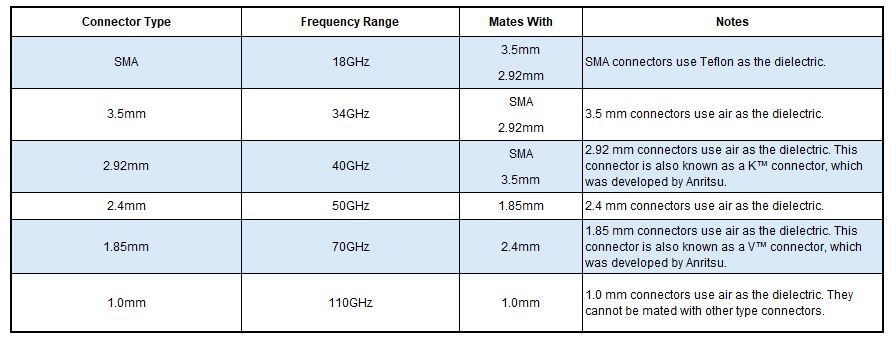
SMA, 2.92 mm, and 3.5 mm connectors can be mated. However, a damaged or an out of spec SMA connector can damage a 2.92mm connector or 3.5mm connector. This is due to the 2.92mm and 3.5mm use of air dielectric construction, which makes them fragile. The SMA's pin engages first, the threads are second. The 3.5mm and 2.92mm connectors are the opposite. The threads mate first, then the pin mates second. Please note: The lowest frequency connector sets the highest frequency use of that connector combination. For example, if one uses an SMA connector (18 GHz) with a 3.5mm connector (34 GHz), the highest useable frequency is 18 GHz (set by the SMA connector). For very precise measurements, connecting different types of connectors results in a small but measurable discontinuity; VNA work should usually use adapters of similar construction.
Key Takeaways
- SMA, 2.92 mm, and 3.5 mm connectors can be mechanically mated, but performance is limited by the lowest frequency-rated type used.
- Differences in dielectric and contact design (solid vs air dielectric) mean mismatched mating can introduce electrical discontinuities.
- For precision, repeatability, and high-frequency operation, use adapters or matched connector pairs rather than direct inter-mating.
- Protect fragile air-dielectric connectors by minimizing unnecessary inter-matings and using proper alignment techniques.
What Are the Mating Rules for SMA, 2.92 mm & 3.5 mm RF Connectors
SMA, 2.92 mm (often called “K”), and 3.5 mm connectors are all popular threaded RF interfaces used in microwave and millimeter-wave systems, and they can be mated together in many cases, but there are some important rules and limitations to follow.
Mechanically, these connectors share similar threading and physical dimensions, which makes inter-mating possible. However, differences in internal design, especially related to dielectric and contact geometry, mean you should understand how and when it’s appropriate to do so.
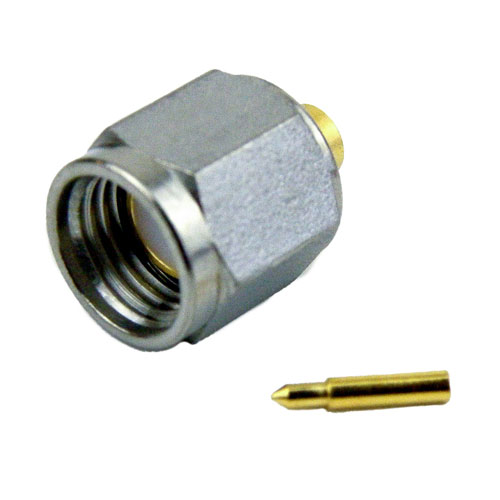
An SMA’s center pin will generally engage first when connecting, whereas air-dielectric connectors like 2.92 mm and 3.5 mm engage the outer contact first. This difference makes the air-dielectric connectors more fragile, so care is important when mating with SMA connectors
Why Proper Mating Matters for RF Performance
In RF and microwave systems, even very small physical mismatches at the connector interface can cause measurable electrical performance issues. At higher frequencies, where wavelengths are short and precision matters, any imperfect contact, gap, or dimensional deviation becomes an impedance of discontinuity that can reflect energy, increase VSWR, or distort signals.
For example, a 3.5 mm connector is designed around an air-dielectric interface that supports very low VSWR and stable performance up to 26.5 GHz or beyond. Connecting it directly to an SMA may introduce a slight discontinuity measurable on a Vector Network Analyzer because the solids and clearances differ. For casual use below the lowest rated operating frequency, this is usually acceptable, but for precise, repeatable microwave measurements it’s best to avoid mismatched mating when possible.
Using quality adapters specifically designed for inter-connecting different connector types helps protect sensitive interfaces especially in test labs where repeated mating cycles occur and preserves both mechanical durability and electrical performance over time.
Best Practices for Mating These RF Connectors
1. Match connectors when possible:
Whenever feasible, use connectors of the same type and specification (e.g., SMA to SMA, 2.92 mm to 2.92 mm, 3.5 mm to 3.5 mm) for the best electrical performance and repeatability.
2. Use adapters for inter-mating:
When inter-mating different connector types (like SMA to 2.92 mm), use a proper RF adapter rated for the intended frequency range to protect the connectors and maintain signal integrity.
3. Watch connector frequency ratings:
The lowest rated connector determines performance; an SMA–to-3.5 mm connection won’t reliably exceed the SMA’s frequency limits.
4. Minimize wear on fragile connectors:
Air-dielectric connectors like 2.92 mm and 3.5 mm have more delicate internal structures than a solid-dielectric SMA. Excessive repeated mating without careful alignment can damage these interfaces over time.
RF Connector Mating Matrix for Similar Type Connectors
FAQs (Frequently Asked Questions)
Q1: Can SMA connectors be mated with 2.92 mm or 3.5 mm connectors?
A: Yes, SMA can be mated with 2.92 mm or 3.5 mm connectors, but the performance will be limited by the lower frequency rating of the SMA when inter-mated.
Q2: Will mismatched mating damage the connectors?
A: Repeated inter-mating especially with cheap or out-of-spec SMA connectors can damage the more delicate air-dielectric sockets of 2.92 mm and 3.5 mm interfaces.
Q3: Why do connectors like 2.92 mm and 3.5 mm have better high-frequency performance?
A: They use air dielectric and precision mechanical tolerances that reduce loss and maintain impedance control at higher microwave frequencies than typical SMA construction.
Q4: Should I ever mate different connector types directly on test equipment?
A: For high-precision measurement, it’s best to use high-quality adapters rather than directly mating different connector types to maintain accuracy and protect expensive ports.