


Frequency Downconverter, upconverter, multiplier, divider, mixer, or frequency translator? What is an RF Mixer?
Not to be confused with awkward socials at microwave industry events, RF Mixers are fundamental building blocks of many RF circuits and systems. The basic function of a RF mixer is frequency translation. Frequency translation shifts the frequency content of a signal, or set of signals, to another part of the spectrum. There are a variety of mixer types, some with specific applications and others that can be used in a variety of circuits as a basic mixer.
Key Takeaways
An RF mixer is a versatile frequency-translation device that can act as a downconverter, an upconverter, a multiplier, or a divider depending on how input signals are combined. Mixers use non-linear elements to produce new frequencies, typically the sum and difference of input frequencies. When properly designed, they allow signal frequency translation without distorting modulation or introducing excessive noise. Choosing the right mixer depends on critical parameters such as conversion loss, image rejection, spurious level, and isolation. In modern RF systems, mixers are used for everything from satellite receivers and transmitters to radar, test equipment, and wireless communication infrastructure.
What Is an RF Mixer?
An RF mixer is an essential component in modern radio frequency systems that combines two input signals to produce new frequencies, typically the sum and difference of the original signals. Mixers are used to translate signals from one frequency to another, enabling efficient transmission, reception, and signal processing in applications such as communications, radar, and test equipment. They form the backbone of frequency conversion and are critical for both upconversion and downconversion processes in RF systems.
Frequency Downconverter vs Upconverter
RF systems often require either upconversion or downconversion to move signals to the desired frequency range. A frequency upconverter takes a lower-frequency signal and shifts it to a higher frequency suitable for transmission over air or through certain communication channels. Conversely, a frequency downconverter takes a high-frequency signal, such as one received from an antenna, and converts it to a lower, more manageable intermediate frequency (IF) for easier processing and analysis. Understanding the difference ensures proper mixer selection for your system.
Multipliers and Dividers in RF Systems
Multipliers and dividers are specialized forms of frequency conversion. Multipliers increase a signal’s frequency by a fixed integer factor, which is useful for generating higher-frequency signals from a lower-frequency source. Dividers, on the other hand, reduce a signal’s frequency, providing a lower-frequency version of a high-frequency signal for measurement or system compatibility. Both play a crucial role in RF system design and in achieving precise frequency control.
How RF Mixers Work
RF mixers operate by combining two input signals, commonly referred to as the local oscillator (LO) and the radio frequency (RF) signal, through non-linear circuit elements, such as diodes or transistors. This interaction generates new signals at the sum and difference of the original frequencies. The choice of mixer type, circuit design, and components determines performance characteristics like conversion loss, isolation, linearity, and frequency range, all critical for system reliability.
RF mixers are used in situations where the baseband or intermediate frequency (IF) is below that of the RF carrier frequency. A common reason for the use of a baseband or IF frequency is that the analog to digital converse (ADCs) and digital to analog converters (DACs) used to digitize and synthesize the signal may not have the bandwidth to directly digitize or synthesize the RF, and one or more intermediate frequency stages are needed to translate the signal to a useable frequency.

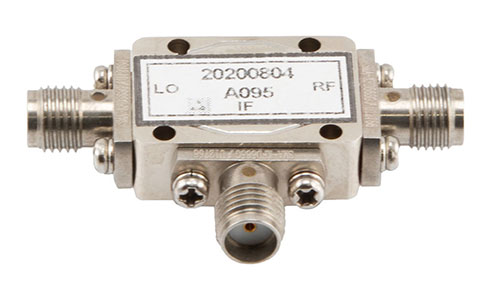
RF Mixer with SMA Connectors
Basic mixers are three terminal RF devices. One port is typically designated as the RF port, which is the higher frequency port. Another is the IF port, which is the lower frequency port. The last port is the local oscillator (LO) port. It is important to remember that RF Mixers of every sort are intrinsically nonlinear devices. Hence, they don’t just produce the desired RF or IF output, but also produce harmonics that are a function of the two inputs, and other nonlinearities, such as spurs. To help with this, RF Mixers are often followed by a band-pass, low-pass, high-pass filter, depending on the requirements of the circuit.
Frequently Asked Questions (FAQs)
Q1: What is the difference between a mixer and a frequency multiplier?
A: A mixer combines two input frequencies to produce output frequencies equal to the sum and difference of its inputs. A frequency multiplier uses non-linear characteristics to generate integer multiples of a single input frequency. While a mixer can shift frequency up or down or translate bands, a multiplier simply increases frequency without combining two signals.
Q2: Can I use a mixer to both downconvert and upconvert
A: Yes. A mixer can downconvert an RF signal to an intermediate frequency (IF) or upconvert a baseband or IF signal to a higher RF frequency, depending on which signal is used as the local oscillator and which as the RF input.
Q3: What determines the quality of the mixer output
A: Key factors include conversion loss, isolation between ports, spurious suppression, noise figure, and the quality of the local oscillator. Poor design or mismatched impedances can degrade signal quality or introduce unwanted spurs.
Related articles
Peter McNeil | Sep 28, 2022 | RF Mixers
RF mixers are frequency conversion devices that are composed of nonlinear elements that allow for frequency “mixing” of RF, intermediate frequency (IF), and local oscillator (LO) signals. There are two main functions of RF mixers: either upconversion or downconversion. Upconversion is the process of combining two input signals, the IF and LO, to generate multiple combinations (the sum, difference, and harmonics) of the two input signals that are the RF signals. Downconversion is the reverse process of upconversion, where the two input signals, RF and LO, are combined to yield the IF signals.
Double Balanced RF Mixer
