Key Takeaways
- RF cables are designed specifically for high-frequency signal transmission, unlike standard electrical wires.
- Most RF cables use coaxial construction to maintain impedance control and minimize signal loss.
- Shielding plays a critical role in protecting RF signals from electromagnetic interference.
- Different RF cable types are optimized for frequency range, flexibility, power handling, and environment.
- Proper RF cable selection is essential for signal integrity, system reliability, and performance.
How an RF Cable Works
An RF cable works by transmitting high-frequency electrical signals from one component to another while minimizing signal loss and interference. The signal travels through the center conductor, while the surrounding dielectric maintains a consistent spacing that controls impedance. The outer shielding confines the electromagnetic field within the cable and blocks external interference, ensuring stable and reliable signal transmission. This controlled structure allows RF cables to carry signals over a wide frequency range with minimal reflection, attenuation, and noise, critical for RF, microwave, and high-speed communication systems.
Common Types of RF Cables
RF cables are available in several types, each designed to meet specific performance and installation requirements. Flexible RF coaxial cables are widely used due to their ease of routing and versatility in general RF applications. Semi-rigid RF cables provide superior phase stability and low loss, making them ideal for high-frequency and precision systems. Low-loss RF cables are engineered with advanced dielectric materials to reduce attenuation over longer distances. High-frequency and microwave cables are optimized for gigahertz-level performance, supporting applications such as radar, satellite communications, and test and measurement environments.
Key Applications of RF Cables
RF cables are essential components across numerous industries where high-frequency signal integrity is critical. They are commonly used to connect antennas, transmitters, receivers, and amplifiers in wireless communication systems. In test and measurement setups, RF cables ensure accurate signal delivery between instruments and devices under test. RF cables also play a vital role in aerospace, defense, broadcasting, medical equipment, and industrial automation, where reliable and interference-free signal transmission is required under demanding operating conditions.
There are several commonly used methods of carrying electromagnetic energy along conductive pathways. The most common of which for RF applications are RF cable assemblies, such as coaxial cable or twisted pair. The better shielding and lower loss capability of coaxial cable means that for frequencies over a couple hundred-megahertz, coaxial cable assemblies are the most commonly used for high frequency applications from hundreds of megahertz to over 110 GHz. These cables are used in virtually every RF application, from home fixed wireless access to space communications. There are RF cable assemblies made for every environment RF equipment is used, including automotive, train/rail, marine/naval, aerospace, military/defense, and commercial.
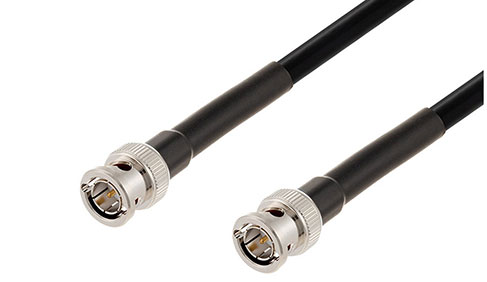
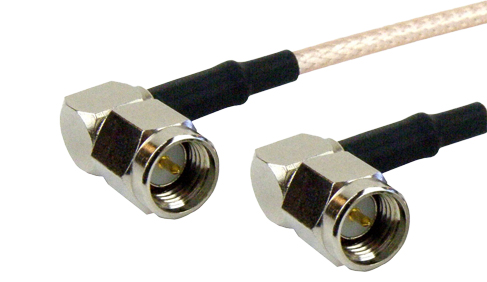
RF coaxial cable assemblies are composed of three separate components and the method of attachment between the components. Each coaxial cable assembly has a coaxial cable and two coaxial connectors. The coaxial connectors need to be compatible with the coaxial cable, but not necessarily the same coaxial connector type. A coaxial cable assembly needs to be attached, or otherwise manufactured, in such a way that the coaxiality of the transmission line is maintained throughout the assembly. Coaxiality refers to the alignment of the inner conductor of the cable or connector and the outer shielding of the cable or connector. In some cases, a RF cable assembly may have a connector that is not a coaxial connector, but instead a banana connector or even exposed center conductor for specific use cases.
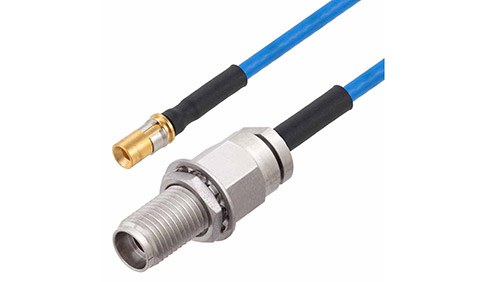
Coaxial Cables typically have a center conductor, dielectric spacer, an outer conductor, and an outer cable jacket. There may be a variety of additional layers to enhance environmental protection, physical ruggedness, or to enhance electrical performance. Though the most common type of coaxial cable found as cable assemblies is flexible cable, or flex cable, there is also rigid and semi-rigid coaxial cable. These cables tend to exhibit better electrical performance than flexible coaxial cables at the cost of less physical flexibility and the flexibility to be used in a variety of applications. RF Cables may have one of a variety of different connectors, the most common of which are threaded coaxial connector types, such as SMA, N-type, 4.3-10 DIN, 3.5mm, etc. There are also several common types of coaxial connectors that are push-connect, such as SMP, MCX, MMCX, QMA, and others. Bonnet style fittings are also common but are limited in frequency to 2 GHz. Different connectors can be used for each end of the coaxial cable assembly, but it is important to note that the maximum frequency of the cable, and many other of the electrical performance parameters, will be limited by the lowest rated of the coaxial cable assembly components
Recommendations
For Engineers & Designers
- Select RF cables based on frequency range, impedance (50Ω or 75Ω), and loss requirements.
- Minimize adapters and transitions to reduce signal reflections.
- Consider environmental conditions such as temperature, vibration, and moisture.
For Installers & Maintenance Teams
- Avoid tight bends beyond the cable’s specified bend radius.
- Ensure connectors are properly torqued to maintain signal integrity.
Inspect cables regularly for jacket damage or connector wear.