Peter McNeil | Feb 02, 2026 |
Combiner RF Combiner Splitter
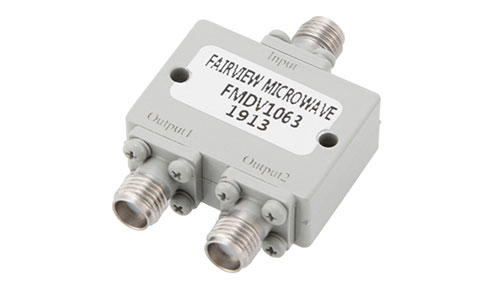
The short answer is, yes. A RF splitter and combiner are the same passive network devices, and to use a splitter as a combiner, the input signals are placed in the combining ports of the splitter, where the combined output is then available at the splitter input port. Typically, power divider/combiners are designed and packaged in such a way that the splitter input port/combiner output port are clearly designated as isolated (often on the opposite side of the package) from the splitter output ports/combiner input ports. With surface mount technology (SMT) or highly compact divider/combiners, the ports may be less clearly designated, but port designations should be clearly labeled or otherwise indicated in the documentation.
Key Take-away
- A RF splitter and a RF combiner are in many respects for the same type of passive device—they are reciprocal under ideal conditions.
- In some cases, a splitter can be used as a combiner by reversing the input/output roles (i.e., feeding signals into what were originally output ports and using the original input as the combined output).
- However, using a splitter as a combiner is subject to important limitations, differences in isolation between ports, mismatches in impedance, power combining losses, phase and amplitude balance issues.
- For proper combiner use—especially where signals from multiple sources are combined into one output under strict performance / interference constraints, it may be more appropriate to use a purpose-built combiner with the right specifications.
- The performance when used as a combiner may degrade (higher losses, less isolation, increased reflections or inter-port coupling) compared to a device designed strictly as a combiner.
In many applications, a power divider/combiner is used for both functions. An example of this is with a phased array antenna system that uses a hybrid or analog architecture. With these architectures the RF source is divided, and that energy is split to several antenna elements with phase shifters and possibly attenuators during transmission. During reception, the phase shifted energy is combined through the power combiner and sent to the receiver.
As power divider/combiners are non-ideal passive networks, there is some insertion loss and imperfect isolation between the ports. Amplitude and phase balance are also a common electrical specification parameter for RF power divider/combiner components. Lastly, a given power divider/combiner circuit will typically only operate over a set frequency range, with a finite bandwidth less than that of the interconnect interface used in the packaging of the component.
Frequently Asked Questions (FAQs)
Q1. Can any RF splitter be used as a combiner?
A: Not necessarily. While physically many splitters are reciprocal and can be used as combiners, the performance (especially isolation, loss, port matching) may not meet the requirements of a proper combiner.
Q2. What are the main limitations when using a splitter as a combiner?
A: Key issues include:
Q3. When is it better to use a dedicated RF combiner rather than repurpose a splitter?
A: When the system demands high performance: combining signals from multiple transmitters, high output power, strict isolation, minimal reflection or intermodulation, or when the frequency of band and application is critical.
Q4. Does the frequency range or power rating of the splitter matter when using it as a combiner?
A: Yes, very much. The splitter’s frequency and power specifications apply regardless of direction. Using it as a combiner beyond those ranges or power limits may cause excess loss or damage.
Q5. If a splitter is used as a combiner, do I need to worry about termination of unused ports?
A: Yes. Unused ports in combiners (or reversed splitters) should be properly terminated to avoid reflections or coupling that can degrade performance.
Q6. Is there a simple rule of thumb for combining signals with a splitter?
A: One guideline is: if you are combining equal amplitude and phase signals, and the splitter has good isolation and matching across the band, you may use it as a combiner. But if amplitudes differ, or phase matching is critical, or you have multiple disparate sources, use a dedicated combiner.