
What Are RF Isolators, And What Are They Used For?
RF Isolators are specific cases of RF Circulators where one of the three ports, typically the reverse port in reference to the signal chain, is terminated. This modification of RF Isolators only allows for signal energy to pass in the forward direction, in reference to the signal chain, and heavily “isolates” the upstream signal chain from any reverse reflections or noise/interference injection. RF Circulators/RF Isolators are typically passive ferrite devices that are made in such a way that the internal magnetic fields within the component steer the electromagnetic waves incident at the ports in a certain direction, with these waves exciting at the nearest port in the direction of travel.
Key Takeaway
An RF isolator is a two-port device that allows RF/microwave power to pass in one direction while blocking or absorbing it in the reverse direction.
Isolators protect sensitive RF components (such as transmitting amplifiers or antenna feeds) from reflected power caused by mismatched loads, detuning, or excessive VSWR.
Key specs to look at include isolation (dB), insertion loss (dB), power rating (W), frequency range, and connector/impedance compatibility. For example, some Fairview isolators offer 20 dB isolation minimum, insertion loss as low as 0.35 dB, and operate up to 40 GHz.
Applying isolators helps maintain system stability, prevent damage and minimize downtime or performance degradation in RF systems.
In multi-transmitter or shared antenna systems, isolators help suppress inter-modulation and unwanted coupling between sources.
As the name implies, RF Isolators are predominately used to isolate upstream signal chain components, which are typically more sensitive components, from reflections from downstream components. It is critical for an RF Isolator to have a well matched termination in the reverse port to optimize the isolation. With a well matched termination on the reverse port, the majority of the reflected/reverse signal energy from the output port will be directed to the termination and dissipated and heat.
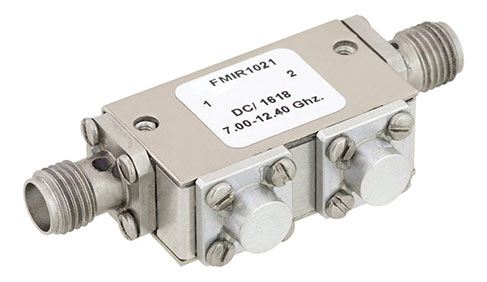
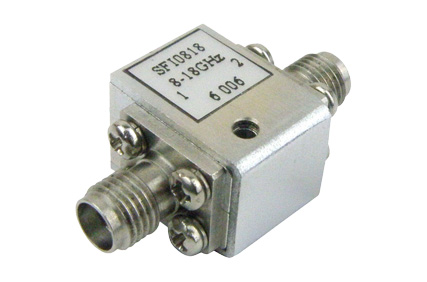
RF Isolator with SMA Ports
It is possible to make an RF Isolator from an RF Circulator by just terminating the reverse port. However, factory designed RF Isolators will likely have much better matched terminations and are designed and tested to operate over the entire frequency range and to the specified power levels. It is also likely that pre-manufactured RF Isolators will be more compact and plug-and-play compared to a RF Isolator made from an off-the-shelf RF Circulator. The isolation of an RF Isolator is directly related to the quality of the match of the termination.
Recommendations
Define your protection requirement: Evaluate if your amplifier or critical RF chain is susceptible to reflections, mismatch or reverse power, then select an isolator with appropriate isolation and power rating.
Choose the correct frequency band and connector type: Make sure the isolator covers your operational band and matches your connector type (e.g., SMA, Type-N, waveguide) and impedance.
Minimize insertion loss: Even though isolators add some loss, pick one with the lowest practical insertion loss to preserve RF system efficiency.
Install correctly: Place the isolator as close to the vulnerable component as possible (e.g., near the amplifier output or feedline) so that reflected signals are immediately absorbed rather than reaching the amplifier.
Maintain proper grounding and termination: Ensure the isolator load port (in some designs) is properly terminated and that the system’s impedance is matched, so the isolator performs as intended.
Frequently Asked Questions (FAQs)
Q1. What is the difference between an RF isolator and an RF circulator?
A: An RF isolator is essentially a two-port device that allows power in one direction and absorbs power in the reverse direction. A circulator is a three-or-more-port device where power entering one port is directed to the next port in sequence and so on.
Q2. Do I always need an isolator for my RF amplifier?
A: Not always. If your load is well matched and the system rarely experiences reflections or detuning, you might not need an isolator. But if you have variable loads, mismatches, shared antennas, or high-power transmitters, an isolator adds meaningful protection.
Q3. How much isolation is enough?
A: It depends on your system’s vulnerability to reflections. Typical devices offer 20-30 dB of isolation; some high-spec isolators or cascaded units reach higher (e.g., 40-60 dB). The needed level depends on amplifier tolerance, system VSWR, and criticality of protection.